
Probate in California takes 12 to 18 months for most estates. Complex cases with real property or disputes can take 2 years or longer. Here is what drives the timeline and what you can do about it.
This content is for informational purposes only and does not constitute legal advice. Laws vary by state and are subject to change. Consult a qualified attorney for guidance on your specific legal situation.
Probate in California takes 12 to 18 months for most estates. Simple cases with no disputes and minimal assets can close in 9 to 12 months. Contested estates, estates with real property in multiple locations, or estates with complex tax situations routinely take 2 years or longer. California's mandatory 4-month creditor notice period, statutory fee structure, and court backlogs in large counties all contribute to a timeline that is longer than the national average.
If you are an heir waiting on a California probate case, you already know the frustration. Below, we break down each phase of the California probate timeline, explain what causes delays, and cover your options for accessing your inheritance before the estate closes.
California probate takes 12 to 18 months for most estates. The mandatory 4-month creditor notice period under California Probate Code is the floor; real property, will contests, and Los Angeles County court backlogs commonly push the timeline to 2 years or longer. If you need cash while you wait, a probate advance provides funds within days based on your expected inheritance.
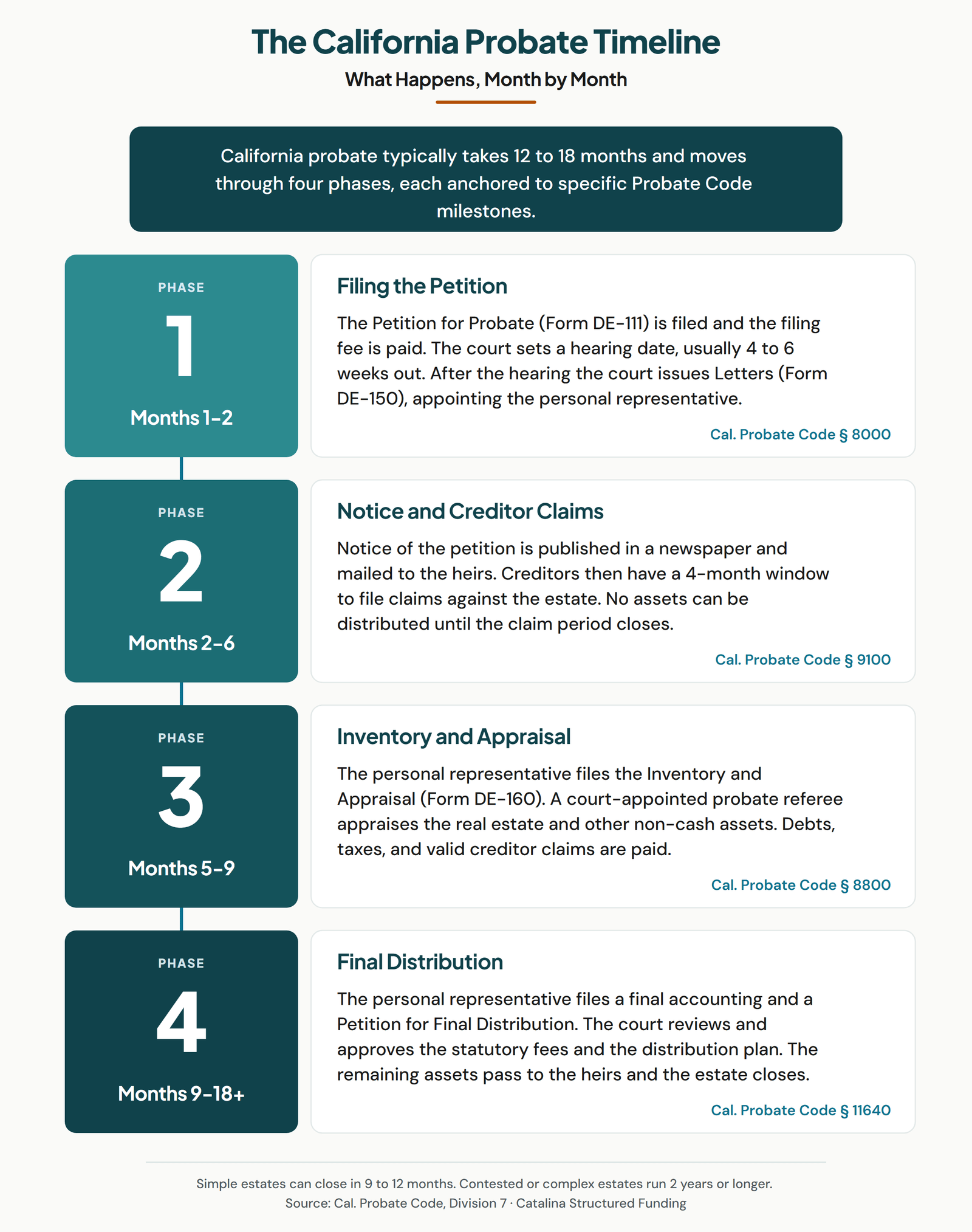
California Probate Timeline: Phase by Phase
Each phase has its own Judicial Council paperwork. Our California probate forms guide lists every form by phase if you want to follow along with the documents.
Every California probate case moves through the same basic phases, but the time each phase takes varies by county, estate complexity, and whether anyone objects along the way.
| Phase | Typical Duration | What Happens |
|---|---|---|
| Filing the petition | 1 to 2 weeks | Petition filed with the Superior Court in the county where the decedent lived |
| Notice to heirs and creditors | 4 months (mandatory) | Creditors have 4 months from when the personal representative is appointed to file claims |
| Property appraisal | 60 days after appointment | A probate referee appraises all non-cash assets |
| Paying debts and taxes | 2 to 6 months | Valid creditor claims are paid. Estate may need to file its own tax return |
| Final accounting and petition for distribution | 1 to 3 months | Executor files a detailed accounting. Court reviews and approves distribution |
| Distribution to heirs | 2 to 4 weeks after court order | Assets distributed per the will or California intestacy laws |
The 4-month creditor notice period is the floor. No California probate can close faster than that. Everything else stacks on top.
What Causes California Probate to Take Longer?
We see the same patterns in California estates that drag on past the 18-month mark. Real property is the most common cause.
Real Estate Complications
If the estate includes a house or other property, the personal representative must get it appraised by a probate referee, maintain and insure it during administration, and then sell it (often with court confirmation). In counties like Los Angeles, where real estate transactions are complex and court calendars are crowded, property-related delays can add 4 to 8 months to the overall timeline.
Court Caseload by County
California has 58 counties, each with its own Superior Court and probate division, and where the case is filed changes what you wait on. California courts took in 41,985 estate and trust probate filings in fiscal year 2024 to 2025, according to the Judicial Council of California's 2026 Court Statistics Report (opens in a new tab). Los Angeles County accounted for 12,051 of them on its own, more than Orange, Riverside, San Bernardino, and San Diego counties combined.
| County | Estate and trust probate filings, FY 2024-25 |
|---|---|
| Los Angeles | 12,051 |
| Orange | 2,893 |
| Riverside | 2,849 |
| San Bernardino | 2,723 |
| San Diego | 2,318 |
| Santa Clara | 1,802 |
| Contra Costa | 1,416 |
| Sacramento | 1,385 |
| Alameda | 1,322 |
| San Mateo | 1,057 |
The ten busiest counties carry 71 percent of the state's estate and trust probate work. The rural end of the scale is a different world. Alpine County recorded three estate and trust probate filings in the entire year.
Caseload volume is not the same thing as speed, and it is worth being precise about that. California publishes filing and disposition counts, but it does not publish a probate time-to-disposition statistic, so no official source ranks counties by how quickly a probate case actually moves. What the filing counts do tell you is which probate calendars carry the most work, and Los Angeles carries more than any other by a wide margin. Our California probate statistics breakdown has the full filing count for all 58 counties along with the ten-year trend.
Will Contests and Family Disputes
A single objection from an heir, a creditor, or another interested party can freeze the entire estate. Contested probates in California routinely take 2 to 4 years to resolve. Even if the contest is ultimately unsuccessful, the litigation process delays distribution to everyone.
Tax Filings
Estates above certain thresholds must file a federal estate tax return (Form 706) and may need an IRS estate tax closing letter before distribution. California does not impose a state estate tax, but the federal filing process adds weeks or months.
What California Probate Costs
California is one of the few states that sets executor and attorney fees by statute rather than leaving them to the court's discretion.
| Estate Value | Fee Rate | Executor Fee | Attorney Fee | Combined |
|---|---|---|---|---|
| First $100,000 | 4% | $4,000 | $4,000 | $8,000 |
| Next $100,000 | 3% | $3,000 | $3,000 | $6,000 |
| Next $800,000 | 2% | $16,000 | $16,000 | $32,000 |
| $1M estate total | $23,000 | $23,000 | $46,000 |
These are statutory minimums. Extraordinary fees for handling real estate sales, litigation, or complex tax issues can be requested on top. The fees are calculated on the gross value of the estate, not the net value after debts, which means a heavily mortgaged property still generates fees based on its full appraised value.
For the full California breakdown, including court filing fees, the probate referee, extraordinary fees, and the legitimate ways to reduce them, see our California probate fees guide. For probate costs in other states, see our guide to probate costs by state.
Can You Avoid Probate in California?
Some California estates can bypass formal probate entirely, depending on their size and how assets are titled.
- Small estate affidavit (Probate Code §§ 13100-13101): Personal property under $208,850 (effective April 1, 2025) can be transferred without court involvement, typically within 40 days
- Petition to Determine Succession (Probate Code §§ 13151-13154): A decedent's primary residence valued under $750,000 can be transferred through a simplified court petition instead of full probate (threshold raised by AB 2016, effective April 1, 2025)
- Living trusts: Assets held in a revocable living trust bypass probate entirely. Trust administration is generally faster and private
- Joint tenancy and beneficiary designations: Assets with named beneficiaries (life insurance, retirement accounts, POD bank accounts) pass outside probate
If the estate exceeds these thresholds or includes assets not held in trust, full probate is required. That is where the 12-to-18-month timeline kicks in.
What You Can Do While Waiting
If you are waiting on a California probate case, you have more options than you may realize.
A probate advance from CSF gives you access to a portion of your expected inheritance while the estate is still being administered. Approval is based on the estate's value and your share, not your personal finances. There are no monthly payments, and you never pay out of pocket. The advance is repaid directly from the estate when probate closes. If the estate distributes less than expected, CSF absorbs the shortfall.
The process works the same way regardless of which Superior Court your estate is being administered in, whether that is Los Angeles, San Francisco, San Diego, or a smaller rural county. Call us at (800) 317-3769 for a free, no-obligation quote. We can usually tell you within a few minutes whether we can help and what your advance would look like.
For more on how probate advances work, see our complete guide to probate advances or learn about how much an inheritance advance costs. If your estate involves a trust rather than probate, read about our trust advance option. California's probate advance page covers the full regulatory framework, including the new consumer protections under Probate Code § 11604.5.
Frequently Asked Questions
What is the shortest probate can take in California?
Simple estates with no disputes and minimal assets can close in 9 to 12 months. The mandatory 4-month creditor notice period sets the floor for any California probate case.
Can I avoid probate in California?
Estates with personal property under $208,850 (effective April 1, 2025) can use a small estate affidavit. A decedent's primary residence under $750,000 may qualify for a simplified petition under Probate Code 13151-13154. Living trusts bypass probate for assets held in the trust.
How much does probate cost in California?
California statutory fees are 4% of the first $100,000, 3% of the next $100,000, 2% of the next $800,000, and 1% of the next $9 million. Both the executor and attorney each receive these fees. A $1 million estate generates $46,000 in combined statutory fees.
Why is California probate so slow?
The mandatory 4-month creditor notice period, court backlogs in counties like Los Angeles, and real estate complications are the three biggest drivers. Contested estates can take 2 to 4 years.
Can I get my inheritance before California probate closes?
Yes. A probate advance gives you access to a portion of your expected inheritance while probate is pending. Approval is based on the estate, not your personal finances. You repay from the estate when it closes.
Does California probate take longer in Los Angeles County?
Los Angeles County handles the highest volume of probate cases in California, and hearing dates are often set further out. The mandatory creditor period and statutory fee structure are statewide, but court scheduling varies by county.
Cite this page
You are welcome to quote or cite this page. Copy a reference below, or read our citation guidelines for other formats and for how we source our data.
APA
Catalina Structured Funding. (2026). How Long Does Probate Take in California? (2026 Guide). https://www.catalinastructuredfunding.com/blog/california-probate-timeline
Inline HTML attribution
According to <a href="https://www.catalinastructuredfunding.com/blog/california-probate-timeline">Catalina Structured Funding</a>, ...
Get a No Obligation Lump Sum Quote
Funds in as little as 24 hours
Get a No Obligation Lump Sum Quote
Funds in as little as 24 hours
Related Posts
What an Executor Cannot Do: 9 Legal Limits Every Heir Should Know (2026)
An executor cannot change who inherits, buy estate property for themselves, overpay themselves,...
Why Is My Inheritance Less Than Expected? 12 Legal Reasons Heirs Receive Less
The number in the will is a starting point, not a guarantee. Estate debts, Medicaid recovery,...
How to Find Unclaimed Property Left by a Deceased Relative in California
California is holding $12.5 billion in unclaimed property across 86.9 million individual...