

Get a Probate Advance in California
Waiting for probate to close in California? CSF can advance your share of the estate now, no monthly payments. You repay only when the estate settles.
Probate Advances in California
Probate in California can be one of the longest and most expensive processes in the country. If you’re a named beneficiary or heir waiting for a California probate case to close, a probate advance from CSF lets you access your inheritance now, without waiting months or years for the estate to distribute.
California’s probate system is governed by the California Probate Code, and the process can be complex even for relatively straightforward estates. Between mandatory waiting periods, court filing backlogs, creditor notice requirements, and the potential for disputes, most California heirs find themselves waiting far longer than they expected to receive their inheritance.
How a Probate Advance Works
A probate advance is not a loan, it’s a purchase of a portion of your expected inheritance. That means:
- Estate-based approval: Approval is based on the estate’s value, not your personal finances
- No monthly payments: You don’t repay until the estate distributes
- No income verification: Your employment status doesn’t matter
- No risk to you: If the estate distributes less than expected, CSF assumes the risk, not you
California Probate Court System
In California, the Superior Court handles all probate matters. Each of California’s 58 counties has its own Superior Court with a probate division (or at minimum, judges assigned to hear probate cases). The state’s largest counties, including Los Angeles, San Francisco, San Diego, Orange County, Riverside, and Sacramento, have dedicated probate departments with specialized judges who handle estate matters exclusively.
Because probate is handled at the county level, the speed and efficiency of the process can vary significantly depending on where the case is filed. Los Angeles County, for example, handles an enormous volume of probate cases, which can lead to longer wait times for hearing dates. By contrast, smaller rural counties may move more quickly due to lighter caseloads. Regardless of which county your probate case is in, a probate advance from CSF gives you access to funds while the legal process runs its course.
Court speed is county-specific, so we keep guides to the courts where most California estates are filed. Each one covers filing steps, current hearing wait times, and what heirs can do while the case moves:
- Orange County probate court
- San Diego probate court
- Santa Clara probate court
- Alameda County probate court
- Riverside probate court
- San Bernardino probate court
- Sacramento probate court
California Statutory Probate Fees
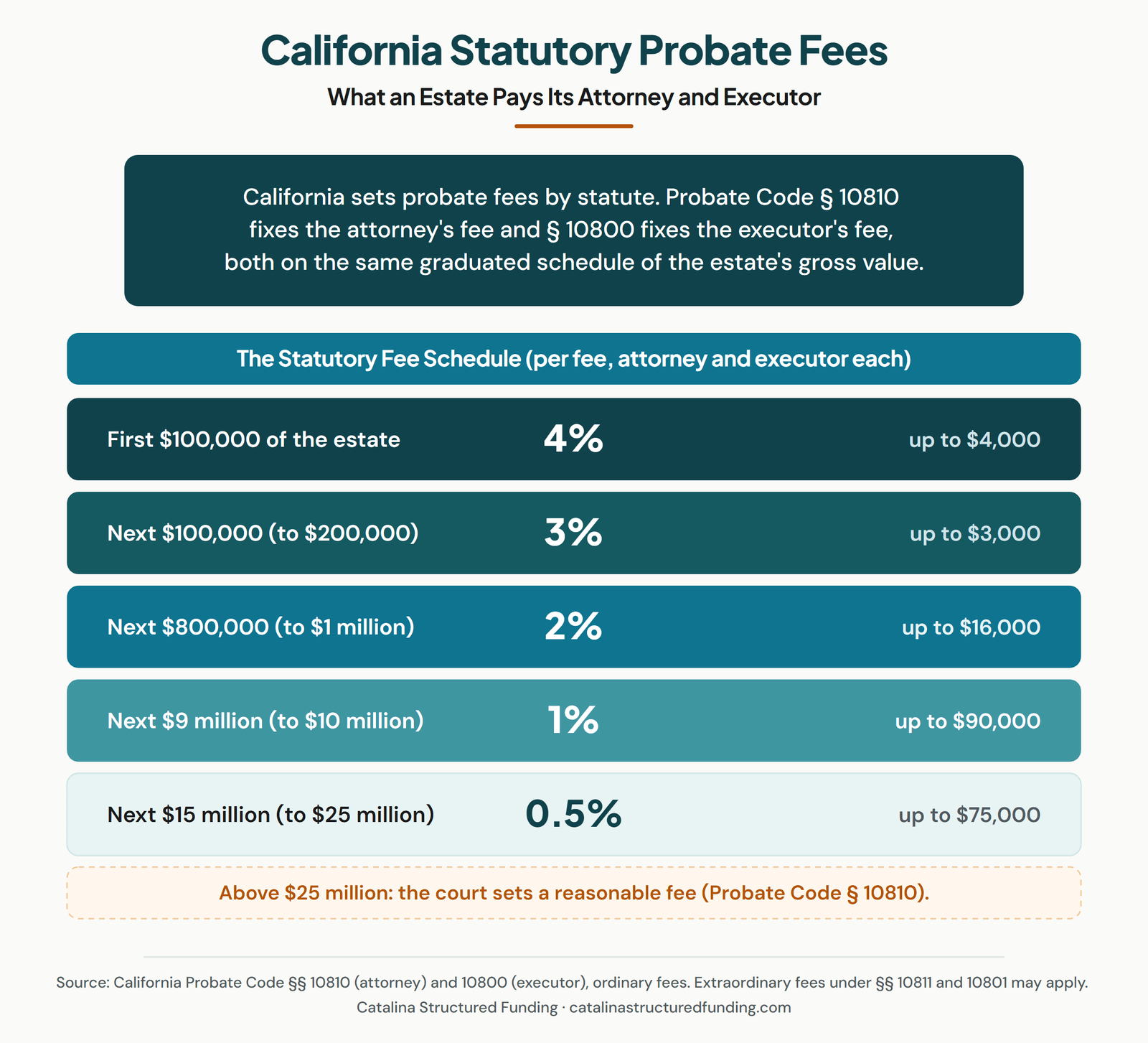
One of the most notable features of California’s probate system is its statutory fee schedule for executor (personal representative) and attorney compensation. Unlike most states where fees are negotiated or set by the court as “reasonable,” California sets fees by statute based on the gross value of the estate:
- 4% of the first $100,000
- 3% of the next $100,000
- 2% of the next $800,000
- 1% of the next $9,000,000
- 0.5% of the next $15,000,000
- A reasonable amount determined by the court for estates above $25,000,000
Both the executor and the attorney each receive this fee schedule, meaning the total statutory fees for both combined are double the amounts listed above. For example, a $1,000,000 estate would generate $23,000 in fees for the executor and $23,000 for the attorney, a total of $46,000 in statutory fees alone. Extraordinary fees for additional work (such as handling real estate sales, litigation, or tax issues) can be requested on top of these amounts. These substantial costs are one reason many California families seek probate advances: the fees reduce the estate’s value, and heirs need to plan accordingly. Our probate advance calculator applies the § 10810 and § 10800 schedules to estimate the dollar range of an advance against your share of a California estate.
California Probate Timeline
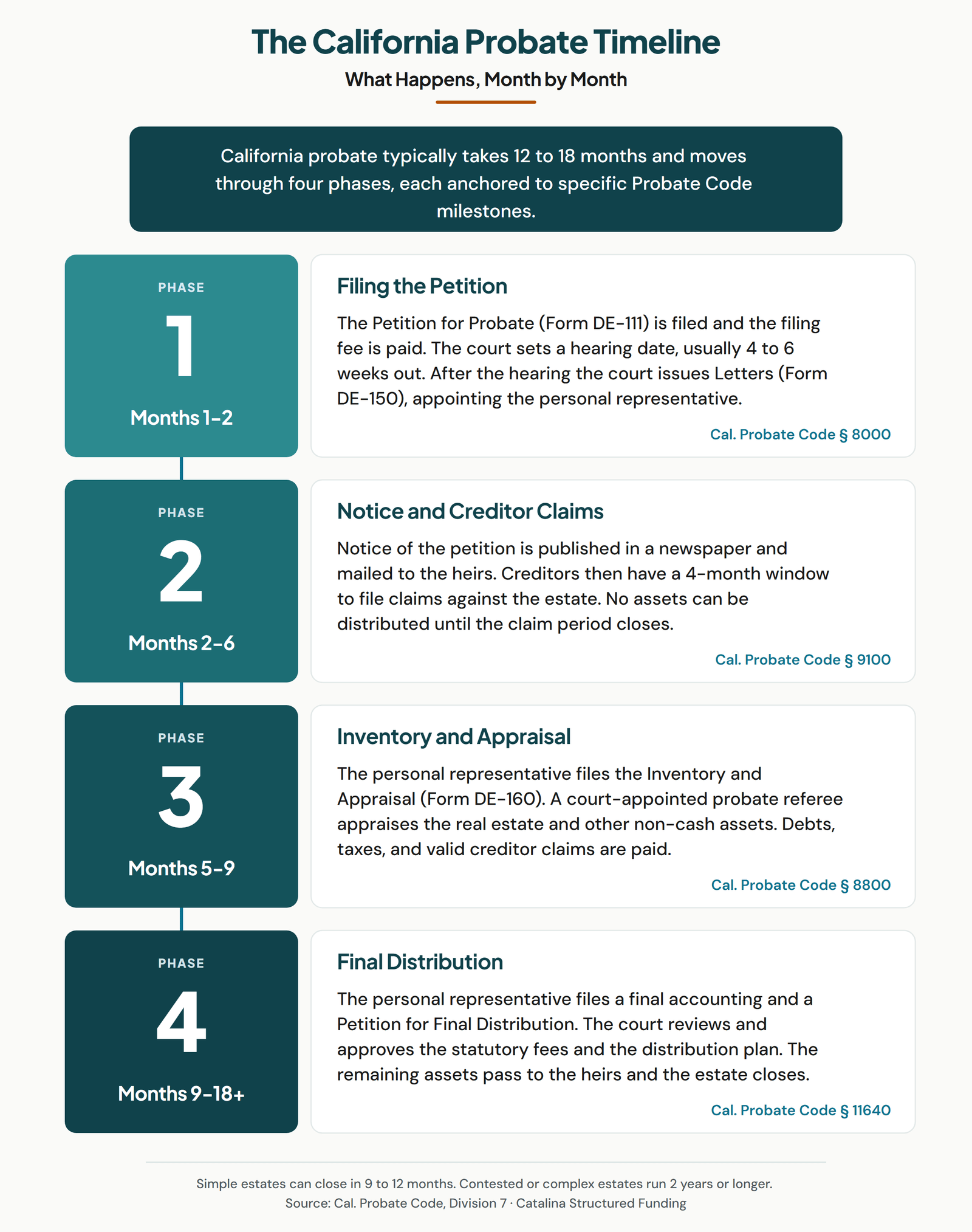
Probate in California typically takes 12–18 months to complete. Simple estates with minimal assets and no disputes may close in 9–12 months, while complex estates involving real property, business interests, tax issues, or family disputes can take 2 years or longer.
Several factors contribute to California’s relatively lengthy probate timeline:
- 4-month creditor notice period: California requires a minimum 4-month window for creditors to file claims against the estate
- Court hearing scheduling: In busy counties like Los Angeles, hearing dates may be set months in the future
- Property appraisals: Probate referees must appraise non-cash assets within 60 days of appointment
- Final accounting: The executor must file a detailed final accounting before distribution
During this extended waiting period, a probate advance from CSF gives heirs access to funds they need now rather than months or years from now.
For a week-by-week breakdown of what happens at each stage, the specific Probate Code sections that drive each deadline, and the most common reasons California cases stall, read our California probate timeline guide.
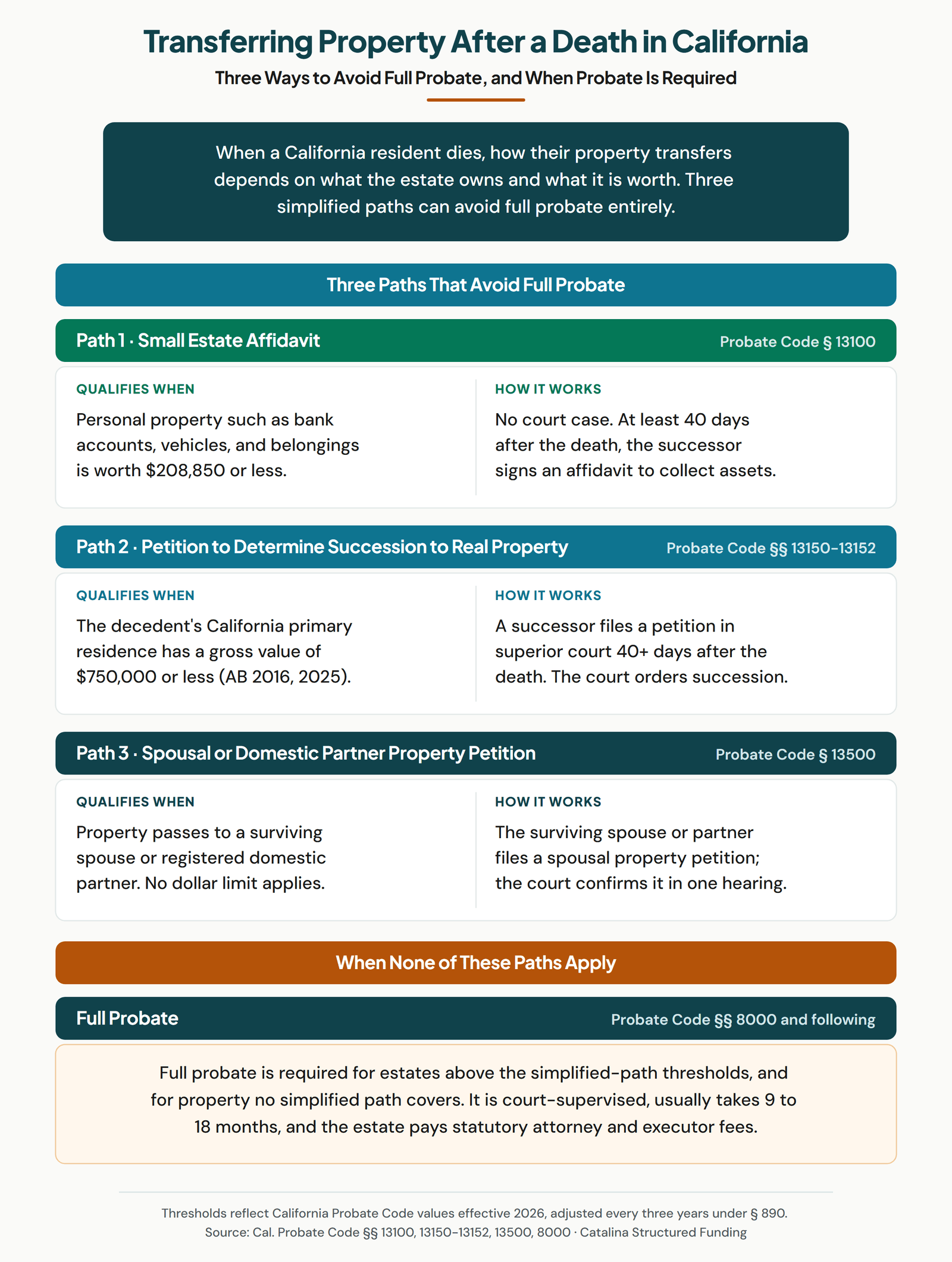
California Small Estate Affidavit
Not all California estates need to go through formal probate. Estates with personal property under $208,850 (effective April 1, 2025, per Probate Code §§ 13100–13101) can be transferred using a small estate affidavit without court involvement, typically within 40 days. For real property, AB 2016 raised the threshold to $750,000 for a decedent’s primary residence (Probate Code §§ 13151–13154), effective April 1, 2025. These thresholds are adjusted every 3 years under Probate Code § 890. If the estate exceeds these limits, full probate is required, and that’s when a probate advance becomes valuable.
Community Property in California
California is a community property state, which means that most property acquired during a marriage belongs equally to both spouses. When one spouse passes away, their community property share (typically 50%) passes through probate, while the surviving spouse retains their half. Separate property, assets owned before the marriage, received as gifts, or inherited, is also subject to probate. Understanding the community property distinction is important because it affects how much of the estate is actually subject to probate and available for distribution to heirs.
California Probate Advance Laws (Probate Code §§ 11604 and 11604.5)
California is the most heavily regulated state in the country for probate advances. Two statutes govern these transactions, and both work in your favor as the heir.
Probate Code § 11604 gives the probate court broad authority to examine any transfer of an estate interest to a third party. The court can investigate the circumstances of the deal and the consideration paid. If the judge finds that the fees were grossly unreasonable or that the transfer was obtained by duress, fraud, or undue influence, the court can refuse distribution or modify the terms. The burden of proving that the consideration was adequate falls on the advance company, not on you.
Probate Code § 11604.5, enacted by SB 1498 and effective January 1, 2023, goes much further. This statute created a comprehensive regulatory framework specifically for companies that regularly purchase beneficial interests in estates. It requires the advance company to file the executed agreement with the court within 30 days. All documents must be in at least 10-point type. The agreement must disclose the exact consideration paid, a description of the transferred interest, and a complete statement of all costs and fees.
The statute also voids certain contract provisions outright. The advance company cannot include hold-harmless clauses (except for beneficiary fraud), cannot grant itself agency powers beyond the transferred interest, cannot require you to pay for unrelated services, and cannot include recourse provisions that let the company come after you personally if the estate distribution falls short. For willful violations committed in bad faith, the court can award you up to twice the value paid for the assignment.
A study published in the Yale Law Journal analyzed 594 probate cases from a major California county and found 77 probate advance transactions. The researchers found that advance companies in those cases paid an average of $808,500 in exchange for $1,378,786 in estate interests, with a mean markup of 69% per year. CSF’s flat-fee probate advance model is built differently. Your fee is locked in on day one, does not compound over time, and is fully disclosed before you sign anything. If the estate distributes less than expected, CSF absorbs the shortfall. You never owe more than what was agreed.
Why a California Inheritance Can Come In Smaller Than the Will Says
California reduces inheritances in two different ways. It pays a strict list of claims out of the estate before beneficiaries see anything, and separately it disqualifies certain people from taking at all. Both halves matter, and the second one surprises people more.
Claims paid before you are
Probate Code § 11420 sets the payment order. Administration expenses come first, including the statutory fees covered above, then secured obligations, funeral expenses, last-illness expenses, the family allowance, wage claims, and finally general debts. No class is paid until every class ahead of it is paid in full.
- The family allowance: the surviving spouse, minor children, and certain dependent adult children draw a reasonable allowance from the estate during administration under Probate Code § 6540, and it ranks fifth, ahead of general creditors.
- Homestead and exempt property set-asides: the court may set apart a probate homestead for a period up to the surviving spouse's lifetime or a child's minority under §§ 6520 and 6524, and exempt property under § 6510, all before distribution.
- Medi-Cal estate recovery: under Welf. & Inst. Code § 14009.5 the state can claim repayment from the estate of a recipient who was 55 or older or institutionalized. The claim is barred entirely if there is a surviving spouse or registered domestic partner, a child under 21, or a blind or disabled child, and hardship waivers exist.
- Creditor claim windows: claims are generally due by the later of four months after letters issue or 60 days after notice under §§ 9100 and 9103, which is part of why a California distribution cannot safely happen early.
People barred from taking
California polices the hands reaching into the estate, not just the size of the pot:
- The slayer rule: a person who feloniously and intentionally kills the decedent takes nothing under Probate Code § 250, and the bar extends to nonprobate transfers and severs a joint tenancy.
- Elder abuse: under Probate Code § 259, a person proven by clear and convincing evidence to have committed physical abuse, neglect, or financial abuse of an elder or dependent adult, in bad faith and with reckless, oppressive, fraudulent, or malicious conduct, is deemed to have predeceased and takes nothing.
- Drafters and caregivers: Probate Code § 21380 presumes fraud or undue influence when a gift goes to the person who drafted the instrument or to a care custodian who served within 90 days of its signing. For the drafter the presumption cannot be rebutted at all, and a beneficiary who tries and fails pays the costs of the fight, including attorney fees.
- An omitted spouse: someone who married the decedent after the will was signed and was left out takes a statutory share under § 21610, up to half of the separate property, which comes out of everyone else's shares.
If any of these are in motion, the estate's math changes while you wait, and that uncertainty is exactly what a probate advance absorbs. Once CSF purchases a share of your expected inheritance, a smaller distribution is our risk, not yours. We review the estate for these issues before we quote, and the amount we quote is the amount you receive. If a § 259 claim, a contested caregiver gift, or a Medi-Cal claim has surfaced in your case, call (800) 317-3769 and tell us early. It changes what we check, not whether we will talk to you. The same rules play out differently elsewhere, and we walk through the full list in our national guide to why an inheritance comes in smaller than expected.
Who Qualifies for a Probate Advance in California
- Named beneficiary in a will admitted to probate in a California Superior Court
- Heir under California intestacy laws (Probate Code §§ 6400–6414) when there is no valid will
- Estate must be in active probate or administration in California
- Estate must have sufficient assets to cover the advance
Probate Advances in Los Angeles
Los Angeles County handles more probate cases than any other county in California. If you are waiting on an estate in the Los Angeles area, CSF has extensive experience with LA County Superior Court probate proceedings. Learn more about probate advances in Los Angeles.
Why California Heirs Choose CSF
- Advances typically funded within 1–2 weeks of approval
- Estate-based approval, no income verification required
- No monthly payments, repayment comes from the estate when probate closes
- Transparent terms you can trust
- Experience with California probate cases across all 58 counties
- Free consultation, (800) 317-3769
Read what other heirs have experienced with our probate advance reviews. If the estate involves a trust rather than probate, learn about our trust advance option. For more background, see our guides on how probate advances work, what probate is, and how long probate takes.
For official information about California’s probate courts and filing requirements, visit the California Courts Self-Help: Probate (opens in a new tab) website.
Ready to Get Your Free Quote?
Find out what your payments are worth. No obligation, no pressure.
Get a No Obligation Lump Sum Quote
Ask about a same day cash advance
Get a No Obligation Lump Sum Quote
A member of our team will reach out to you shortly.
Frequently Asked Questions
How long does probate take in California?
How fast can I get a probate advance in California?
Do I need good credit for a probate advance in California?
Can I avoid probate in California with a small estate?
How much do California probate fees cost?
Is a probate advance a loan in California?
Probate Advances in Nearby States
Other Services in California



Get a No Obligation Lump Sum Quote
Ask about a same day cash advance