
At a glance · verified
- Federal withholding on prizes over $5,000
- 24%
- Top federal income tax rate
- 37%
- Highest state tax on lottery prizes
- 10.9%
- States with no personal income tax
- Nine
- States that run no lottery
- Five
Complete guide to lottery taxes. See federal tax rates, state-by-state lottery tax rates for all 50 states, and how lump sum vs. annuity affects your tax bill.
This content is for educational purposes only and does not constitute tax advice. Tax laws vary by state and individual circumstances. Consult a qualified tax professional or CPA for guidance on your specific tax situation.
If you just won the lottery, one of the first questions on your mind is probably how much you will actually keep after taxes. Lottery winnings are subject to both federal and state taxes. The IRS withholds 24% of any prize over $5,000, and the top federal rate of 37% applies to winnings above $640,600 for single filers in 2026. State taxes vary from 0% in California, Florida, and seven other states to over 10% in New York. Here is what you need to know about lottery taxes, including a complete 50-state tax rate table.
How Lottery Winnings Are Taxed
Lottery winnings are classified as ordinary income by the IRS and are taxed at your applicable federal and state income tax rates. The tax system works in two layers:
- Federal taxes: The IRS automatically withholds 24% on lottery prizes over $5,000. Your actual tax liability depends on your total taxable income for the year, which determines your marginal tax bracket. Most large jackpot winners land in the top 37% bracket.
- State taxes: State lottery tax rates vary from 0% to 10.9%. Some states have no income tax at all, California specifically exempts lottery winnings, and others tax lottery prizes at the standard state income tax rate.
We see winners caught off guard by this: the total effective tax rate on a large jackpot can reach 40% to 50% when combining federal and state taxes. This is one reason many winners choose the annuity payout option, which spreads the income across 30 years and may keep each year's payment in a lower tax bracket. For a detailed comparison, see our guide on lottery lump sum vs. annuity.
Want the full 30-payment schedule? Our lottery annuity calculator lays out every graduated Powerball or Mega Millions payment against the lump sum, with federal and state tax applied to each year. The tax calculator further down this page handles a single prize or a single payment.
Federal Lottery Tax Rates (2026)
The IRS treats lottery winnings as ordinary income. Here are the key federal tax rules for lottery winners in 2026:
- Automatic withholding: The lottery commission withholds 24% of any prize over $5,000 before you receive your check. This is a withholding, not your final tax. Think of it as a prepayment toward your tax bill.
- Top marginal rate: 37% on taxable income above $640,600 (single) or $768,700 (married filing jointly), per IRS Rev. Proc. 2025-11 (opens in a new tab). These rates were made permanent by the One Big Beautiful Bill Act.
- Standard deductions (2026): $15,350 (single), $30,700 (married filing jointly).
Virtually every jackpot winner lands in the top bracket for the year they receive the prize. If you win $10 million as a lump sum, the IRS withholds $2.4 million (24%). But your actual federal tax bill is approximately $3.7 million (37% on most of the income). You owe the difference when you file your return.
The same federal rules apply to casino and slot machine winnings, though the reporting thresholds differ. Our guide to taxes on casino winnings covers the new $2,000 W-2G threshold and the 2026 gambling loss deduction cap.
Lifetime lottery games follow the same annual-installment tax treatment. Each yearly payment from Millionaire for Life, the retired Lucky for Life, or a Set for Life scratch prize is ordinary income in the year received, with 24% federal withholding on qualifying payments.
Slot machine winners face the same brackets with different mechanics, and our timeline of what to do after winning a casino jackpot covers the verification window, the 60-day payout election, and the tax set-aside math.
2026 Federal Tax Brackets (Single Filers)
| Taxable Income | Tax Rate |
|---|---|
| $0 to $12,400 | 10% |
| $12,401 to $50,400 | 12% |
| $50,401 to $105,700 | 22% |
| $105,701 to $201,775 | 24% |
| $201,776 to $256,225 | 32% |
| $256,226 to $640,600 | 35% |
| Over $640,600 | 37% |
Federal Withholding vs. What You Actually Owe
The 24% the lottery withholds is a deposit toward your federal tax, not the tax itself. On a large prize the final bill lands closer to 37%, and you pay the difference when you file.
The withholding rule is 26 U.S.C. § 3402(q) (opens in a new tab), which requires the payer to withhold 24% on lottery proceeds over $5,000. Your liability is set by the ordinary income brackets in IRS Rev. Proc. 2025-32, the same brackets in the table above. The two numbers come from different rules, which is why almost every winner owes more in April.
| $1,000,000 prize, single filer, 2026 | Withheld at payout | Owed at filing |
|---|---|---|
| Rule | Flat 24% on proceeds over $5,000 (26 U.S.C. § 3402(q)) | 2026 brackets, 10% to 37% (Rev. Proc. 2025-32) |
| Federal amount | $240,000 | $325,957 |
| What it is | A prepayment credited on your return | Your final federal liability |
| Result | $85,957 more due when you file, before state tax and before any deductions | |
The $325,957 figure treats the prize as your only income for the year with no deductions, which is the same simplification the calculator below uses. Add a salary and the gap grows, because more of the prize lands in the 37% bracket. Set the difference aside the day the check clears. We see winners spend what looks like the net and then face a five- or six-figure bill the following spring.
Taxes on $5,000 Lottery Winnings
A $5,000 lottery prize is fully taxable as ordinary income, but nothing is withheld automatically. The IRS requires 24% federal withholding only when proceeds exceed $5,000, and proceeds means your winnings minus the cost of the winning ticket. A prize of exactly $5,000 sits at the threshold, so the lottery pays you the full amount and the tax bill arrives when you file.
What you owe depends on your bracket. For a winner in the 22% or 24% bracket, federal tax on a $5,000 prize comes to roughly $1,100 to $1,200. State tax adds anywhere from $0 to about $545 depending on where you live, using the 0% to 10.9% range in the state table below. On a typical draw-game ticket you will also receive a Form W-2G, since the 2026 reporting threshold is $2,000. Higher-priced tickets can fall outside the reporting rules because of the 300-times-the-wager test, but the prize is taxable income either way.
Two practical notes from the winners we talk to. Keep the ticket documentation, since withholding math runs on proceeds after subtracting your wager. And if you collect prizes this size more than once in a year, the combined income can push you into a higher bracket, where quarterly estimated payments are worth discussing with a tax professional.
State Lottery Tax Rates: All 50 States + DC
State lottery tax rates range from 0% to 10.9%. New York taxes prizes at the highest rate of any state that runs a lottery. Nine states have no income tax, and California specifically exempts lottery winnings from state taxation. Five states run no lottery at all, so a resident who wins another state's game owes their home state's income tax instead. The following table shows the top state tax applied to lottery prizes in each state.
| State | Tax on Lottery Prizes | Notes |
|---|---|---|
| Alabama | No lottery | No state lottery; residents owe up to 5.00% on out-of-state winnings |
| Alaska | No lottery | No state lottery; no state income tax |
| Arizona | 2.50% | |
| Arkansas | 3.70% | |
| California | 0% | Lottery prizes exempt from state tax (Gov. Code 8880.68); rate applies to other income only |
| Colorado | 4.40% | |
| Connecticut | 6.99% | |
| Delaware | 6.60% | |
| District of Columbia | 10.75% | |
| Florida | 0% | No state income tax |
| Georgia | 4.99% | |
| Hawaii | No lottery | No state lottery; residents owe up to 11.00% on out-of-state winnings |
| Idaho | 5.30% | Flat rate above a small zero-bracket |
| Illinois | 4.95% | Flat rate on all income |
| Indiana | 2.95% | Flat rate; county income taxes also apply |
| Iowa | 3.80% | Flat rate; school district surtaxes may also apply |
| Kansas | 5.58% | Lottery withholds a flat 5%, below the 5.58% actually owed |
| Kentucky | 3.50% | Flat rate on all income |
| Louisiana | 3.00% | Flat rate on all income |
| Maine | 9.15% | 7.15% plus a 2% surcharge on income over $1M (new for 2026) |
| Maryland | 6.50% | Top rate applies above $1M taxable income; county taxes up to 3.3% may also apply |
| Massachusetts | 9.00% | 5% flat plus the 4% surtax on income over $1,107,750; lottery withholds only 5% |
| Michigan | 4.25% | Flat rate; some cities levy additional tax |
| Minnesota | 9.85% | |
| Mississippi | 4.00% | Flat rate above the first $10,000; steps down to 3% by 2030 |
| Missouri | 4.70% | |
| Montana | 5.65% | Drops to 5.4% in 2027 |
| Nebraska | 4.55% | Drops to 3.99% in 2027 |
| Nevada | No lottery | No state lottery; no state income tax |
| New Hampshire | 0% | No state income tax on lottery winnings |
| New Jersey | 10.75% | |
| New Mexico | 5.90% | |
| New York | 10.90% | NYC residents pay an additional 3.876% city tax; Yonkers residents pay a 16.75% surcharge on their state tax (about 1.83% of the prize at the top rate) |
| North Carolina | 3.99% | Flat rate on all income |
| North Dakota | 2.50% | Top bracket; the 1.95% bracket does not reach a jackpot |
| Ohio | 2.75% | Flat rate as of 2026; municipal taxes may also apply |
| Oklahoma | 4.50% | |
| Oregon | 9.90% | |
| Pennsylvania | 3.07% | Flat rate; local taxes may also apply |
| Rhode Island | 5.99% | |
| South Carolina | 5.21% | |
| South Dakota | 0% | No state income tax |
| Tennessee | 0% | No state income tax |
| Texas | 0% | No state income tax |
| Utah | No lottery | No state lottery; residents owe a flat 4.65% on out-of-state winnings |
| Vermont | 8.75% | |
| Virginia | 5.75% | |
| Washington | 0% | No state income tax |
| West Virginia | 4.58% | Lottery withholds 6.5%, above the 4.58% actually owed |
| Wisconsin | 7.65% | |
| Wyoming | 0% | No state income tax |
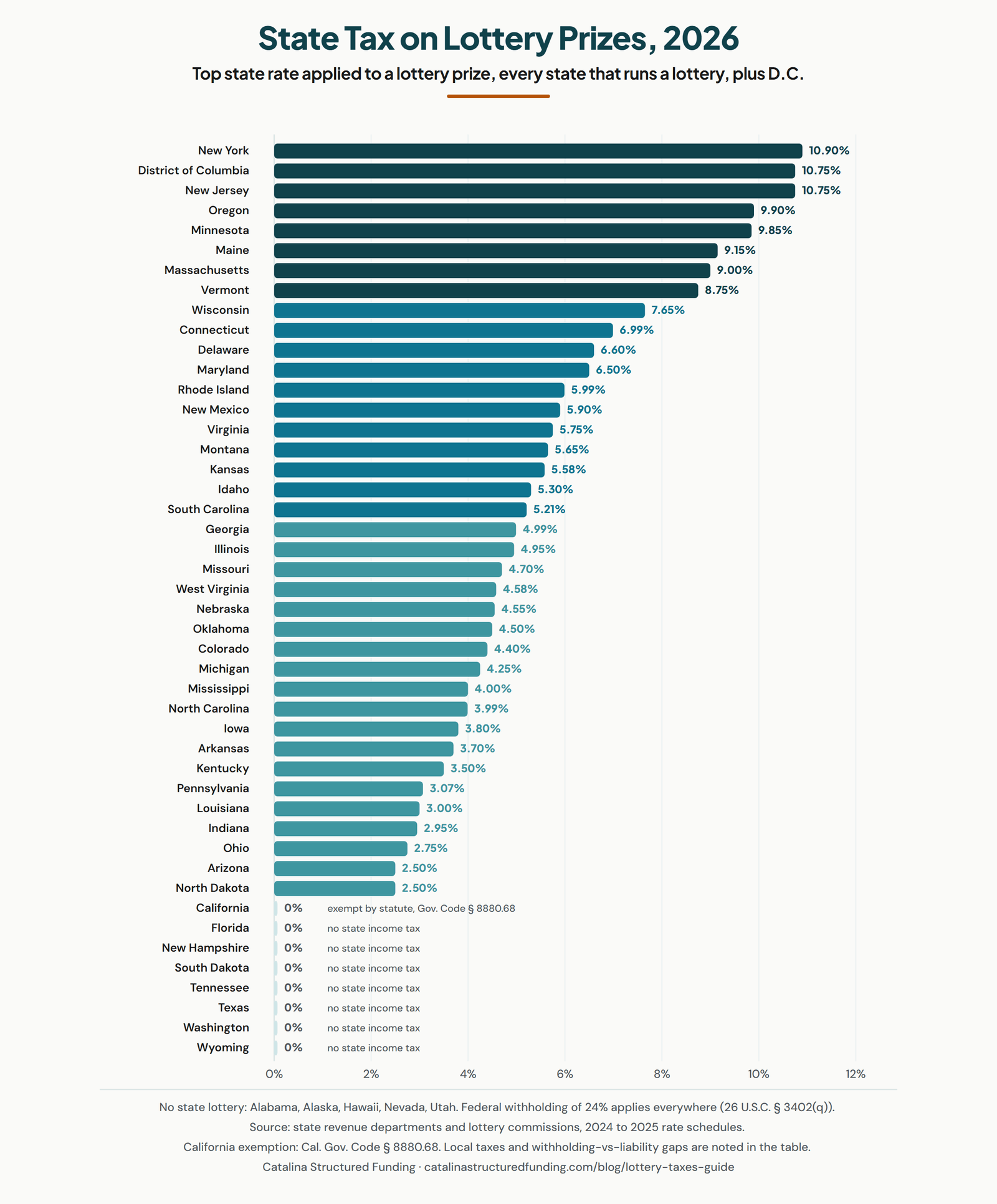
Embed or cite this chart
Copy the snippet below. The link back to this page is the attribution, and it keeps your copy pointed at the current version when a state changes its rate.
<a href="https://www.catalinastructuredfunding.com/blog/lottery-taxes-guide"><img src="https://www.catalinastructuredfunding.com/images/blog/lottery-taxes-by-state-2026.png" alt="State tax on lottery prizes by state, 2026" width="1600" height="1899"></a>
<p>Chart: Catalina Structured Funding, "Lottery Taxes by State (2026)," https://www.catalinastructuredfunding.com/blog/lottery-taxes-guide</p>
To calculate your after-tax payout using these rates, use the lottery tax calculator in the next section. It applies both federal and state taxes to any prize amount.
Lottery Tax Calculator by State
Lottery Tax Calculator
Federal withholding, estimated total federal tax from the 2026 brackets, and your state's lottery tax, on any prize amount.
- Federal tax withheld at payout
- $240,000
- 24.0% on prizes over $5,000
- Estimated total federal tax
- $325,957
- About $85,957 more due when you file
- State tax
- Choose a state
- Rates for all 50 states and D.C. are in the table above
- Estimated take-home
- $674,043
- Federal only until you choose a state
Educational estimate only. The federal figure treats the prize as a single filer's only income for the year, with no deductions or credits, so your actual bill depends on your filing status, other income, and deductions. The 24.0% withholding is a prepayment toward that bill, not the whole tax. Talk to a CPA before you make decisions based on these numbers. This is not an offer or quote from Catalina Structured Funding.
The calculator above applies the 24% federal withholding, estimates your total federal bill from the 2026 brackets, and adds your state's lottery tax rate from the table. It works for a cash lump sum or for a single annuity payment, so you can compare the two with your own numbers. To model all 30 annuity payments against the lump sum, use our lottery annuity calculator.
The state table gives you the rate behind the math for all 50 states plus D.C., and our lottery winnings hub covers each state's payment and transfer rules in more depth. If you are weighing the two payout options, our lump sum vs. annuity comparison answers the question in full.
States with No Lottery Tax
Lottery winners in 10 states pay zero state tax on their winnings:
No state income tax (9 states): Alaska, Florida, New Hampshire, Nevada, South Dakota, Tennessee, Texas, Washington, and Wyoming. These states do not tax any income, including lottery prizes.
Lottery-specific exemption (1 state): California exempts lottery winnings from state income tax under Government Code 8880.68 (opens in a new tab). California does have a state income tax (up to 13.3%), but lottery prizes are specifically excluded.
Important: "No state tax" does not mean "no tax." Federal taxes (up to 37%) still apply regardless of which state you live in.
Five states do not have a state lottery at all: Alabama, Alaska, Hawaii, Nevada, and Utah. If you live in one of these states and win a multi-state game like Powerball or Mega Millions by purchasing a ticket in another state, you may owe taxes in the state where you purchased the ticket. Consult a CPA for guidance on cross-state lottery taxation.
Lump Sum vs. Annuity: Tax Differences
The choice between a lump sum and annuity payout has real tax consequences that can add up to hundreds of thousands of dollars:
Lump sum: The entire prize (minus the cash value discount) is taxed in a single year. For a large jackpot, this almost guarantees you pay the top 37% federal rate on the vast majority of the prize. Your effective tax rate is highest because the full amount stacks on top of any other income you earned that year.
Annuity: Payments are spread over 30 years (for Powerball and Mega Millions, 1 initial payment plus 29 annual payments, each increasing 5%). Each annual payment is taxed as ordinary income in the year you receive it. While large jackpot annuity payments still land in the top bracket, smaller prizes may benefit from lower brackets when spread over time.
Example: A $100 million Powerball jackpot pays approximately $56.2 million as a lump sum (before taxes) or approximately $3.33 million per year for 30 years (increasing 5% annually). The lump sum puts you in the 37% bracket immediately on the full amount. The annuity payments of $3.33 million per year also land in the 37% bracket, but future tax law changes could shift rates up or down over the 30-year period.
For a complete analysis of the financial trade-offs, see our guides on Powerball payouts and Mega Millions payouts. To see current jackpot amounts and estimated after-tax values, visit our live jackpot tracker.
How Selling Lottery Annuity Payments Is Taxed
When you sell lottery annuity payments to a purchasing company like CSF, the lump sum you receive is taxed as ordinary income in the year you receive it.
Key tax facts about selling lottery annuity payments:
- The sale proceeds are treated as ordinary income, not capital gains. Lottery payments have a zero cost basis (you won them), so the full sale amount is taxable.
- The buyer (CSF) does not withhold taxes from the payment. You are responsible for reporting the income on your tax return and paying any taxes owed.
- State taxes apply based on your state of residence at the time of the sale.
- Selling does not create any new tax obligation that would not exist if you received the payments over time. It simply accelerates the income into a single year.
CSF purchases lottery annuity payments in states that allow the sale under their lottery statutes. Not all states permit the assignment of lottery annuity payments. Call us at (800) 317-3769 to find out if your state allows the sale and what your payments might be worth. You can also visit our lottery winnings service page for more details.
A lottery annuity is one type of payment stream CSF buys. If you also hold an insurance annuity, the same basic question applies, since both convert a schedule of future payments into cash today. Our annuity purchasing page covers which payment streams qualify and what the transfer involves.
Considering selling your lottery annuity payments? CSF provides free, no-obligation quotes. The amount we quote is the amount you receive. Call (800) 317-3769 or request a quote online.
Can You Reduce Your Lottery Tax Bill?
Charitable giving, choosing the annuity payout, trust structures, and state residency planning can reduce lottery taxes, but no strategy eliminates the obligation entirely.
Here is a closer look at each approach:
- Charitable giving: Donating to qualified charities can offset some taxable income. The IRS allows charitable deductions up to 60% of adjusted gross income for cash donations to public charities under IRC section 170(b)(1)(A) (opens in a new tab).
- Choosing the annuity: Spreading income over 30 years is itself a tax management strategy. While each annual payment may still land in the top bracket for large jackpots, it provides more time for tax planning each year.
- Trust structures: Some winners establish trusts for asset protection and privacy. A trust does not eliminate income taxes on lottery winnings, but it may help with estate planning and creditor protection. Trust rules for lottery winners vary by state.
- State residency: Moving to a no-income-tax state before claiming a prize may reduce state taxes. This strategy carries legal risks and varies by state. Some states tax based on where the ticket was purchased, not where you live when you claim.
CSF does not provide tax advice. Consult a qualified CPA or tax attorney for strategies specific to your situation and prize amount.
Frequently Asked Questions
How much tax do you pay on lottery winnings?
Lottery winnings are taxed as ordinary income. The IRS withholds 24% on prizes over $5,000, and the top federal rate is 37% on income above $640,600 (single filers, 2026). State taxes add 0% to 10.9% depending on where you live. Total effective tax rates on large jackpots typically reach 40% to 50%.
Which states have no lottery tax?
Nine states have no state income tax: Alaska, Florida, New Hampshire, Nevada, South Dakota, Tennessee, Texas, Washington, and Wyoming. California also exempts lottery winnings from state income tax under Government Code 8880.68. Federal taxes still apply in all states.
Do you pay taxes on lottery winnings every year?
If you chose the annuity option, yes. Each annual payment is taxed as ordinary income in the year you receive it. If you took the lump sum, the full amount is taxed in the year you receive it. Selling lottery annuity payments is also taxed as ordinary income in the year of the sale.
Is it better to take the lump sum or annuity for taxes?
The annuity spreads your tax liability over 30 years, which may result in a lower effective tax rate if future tax brackets remain similar. The lump sum concentrates all taxes in one year at the highest bracket. Taxes are only one factor in this decision. Investment returns, inflation, and personal financial needs also matter. Consult a financial advisor for guidance specific to your situation.
How are lottery winnings taxed in California?
California does not tax lottery winnings at the state level. Government Code 8880.68 exempts lottery prizes from state income tax. Federal taxes still apply. California lottery winners pay only federal income tax on their prizes.
Does the IRS take taxes out of lottery winnings automatically?
Yes. The IRS requires 24% federal withholding on lottery prizes exceeding $5,000. This is not your final tax bill; it is an advance payment. If your total income puts you in the 37% bracket, you will owe additional taxes when you file your annual return.
Can you sell lottery payments to avoid taxes?
No. Selling lottery annuity payments does not eliminate your tax obligation. The lump sum from the sale is taxed as ordinary income in the year you receive it. Selling may be beneficial for other financial reasons, such as paying off debt or investing. CSF purchases lottery annuity payments in states that allow the sale.
How much would you take home from a $1 million lottery win?
On a $1 million prize, the IRS withholds $240,000 (24%). Your final federal tax depends on your total income and filing status, but expect approximately $310,000 to $370,000 in federal taxes. State taxes add $0 to $109,000 depending on your state. After all taxes, a $1 million winner typically takes home $550,000 to $700,000.
Key figures
Every figure below is explained and sourced in the article. Verified as of .
| Figure | Value | Applies to | Source |
|---|---|---|---|
| Federal withholding on prizes over $5,000 | 24% | All states | 26 U.S.C. § 3402(q) |
| Top federal income tax rate | 37% | Taxable income above $640,600 (single filer, 2026) | IRS Rev. Proc. 2025-32 |
| Highest state tax on lottery prizes | 10.9% | New York, of the states that run a lottery | |
| States with no personal income tax | Nine | AK, FL, NH, NV, SD, TN, TX, WA, WY | |
| States that run no lottery | Five | Alabama, Alaska, Hawaii, Nevada, Utah | |
| California tax on California Lottery prizes | None | Exempt by statute | Cal. Gov. Code § 8880.68 |
Sources
4 cited sources. Every authority below appears in the article above and was reviewed by our editorial team. See our editorial standards for our sourcing policy.
- Statute26 U.S.C. § 3402(q) (withholding on certain gambling winnings) (opens in a new tab)The 24% federal withholding on lottery proceeds over $5,000.
- Government sourceIRS Rev. Proc. 2025-32, 2025-45 I.R.B. 695 (tax year 2026 inflation adjustments, including the ordinary income brackets) (opens in a new tab)
- StatuteCal. Gov. Code § 8880.68 (California Lottery prizes exempt from state income tax) (opens in a new tab)
- Statute26 U.S.C. § 170(b)(1)(A) (charitable contribution limit for cash gifts to public charities) (opens in a new tab)
Cite this page
You are welcome to quote or cite this page. Copy a reference below, or read our citation guidelines for other formats and for how we source our data.
APA
Catalina Structured Funding. (2026). Lottery Taxes by State: Federal & State Tax Guide (2026). https://www.catalinastructuredfunding.com/blog/lottery-taxes-guide
Inline HTML attribution
According to <a href="https://www.catalinastructuredfunding.com/blog/lottery-taxes-guide">Catalina Structured Funding</a>, ...
Get a No Obligation Lump Sum Quote
Funds in as little as 24 hours
Get a No Obligation Lump Sum Quote
Funds in as little as 24 hours
Related Posts
Millionaire for Life Payout: How the New Lifetime Lottery Game Pays (2026)
Millionaire for Life pays $1 million a year for life with a 20-year guarantee, or an $18 million...
Lucky for Life Payout: What Winners Receive Now That the Game Ended
Lucky for Life ended February 21, 2026, but winners keep their payments. See the payout structure,...
Is Set for Life Actually for Life? It Depends on Your State
Set for Life scratchers pay a true lifetime annuity in some states and a fixed 20 to 30 year term...