
California Probate Code §§ 6400-6455 sets who inherits when someone dies without a will. The rules turn on community property and marital status. Full framework with leading California cases.
This content is for informational purposes only and does not constitute legal advice. Laws vary by state and are subject to change. Consult a qualified attorney for guidance on your specific legal situation.
If a person dies in California without a valid will, the state's intestate succession laws decide who inherits. California Probate Code §§ 6400 through 6455 sets the order. The surviving spouse and registered domestic partner come first. Children come next, then parents, then siblings, then more remote relatives. The rules also draw a sharp line between community property and separate property, which most other states do not. That distinction is the single biggest source of confusion for California heirs.
Below, we cover what intestate means in California, the order of who inherits, the community-vs-separate property split, the surviving spouse's share, the children's and other relatives' shares, special situations like adopted children and half-blood relatives, and the practical reality that intestate probate runs longer than probate with a will.
What "Intestate" Means in California
Intestate means a person died without a valid will, or with a will that does not effectively dispose of all of their property. California Probate Code § 6400 governs every part of an estate not effectively disposed of by will.
The California Supreme Court has called the intestate succession framework "the statutory will" because it provides the default disposition the legislature thinks most Californians would want if they had thought to write one. (See Estate of Shellenbarger, 169 Cal.App.4th 894 (2008).) For the official statutory text, see California Probate Code §§ 6400-6414 on the California Legislative Information site (opens in a new tab). The framework applies in three distinct situations:
- No will at all. The decedent never executed a will, or the will they executed was found invalid by the court.
- Partial intestacy. A valid will exists but does not effectively dispose of every asset. Common cause: an asset acquired after the will was signed and never added by codicil. The covered assets pass under the will. The uncovered assets pass under intestate succession.
- A failed beneficiary designation. A named beneficiary predeceased the decedent and the will has no contingent beneficiary or anti-lapse provision. That share passes by intestacy unless § 21110 anti-lapse applies.
Whichever situation applies, the analysis starts the same way: identify what kind of property the decedent owned (community or separate), then walk down the priority order set by §§ 6401 and 6402.
How California Distributes an Intestate Estate
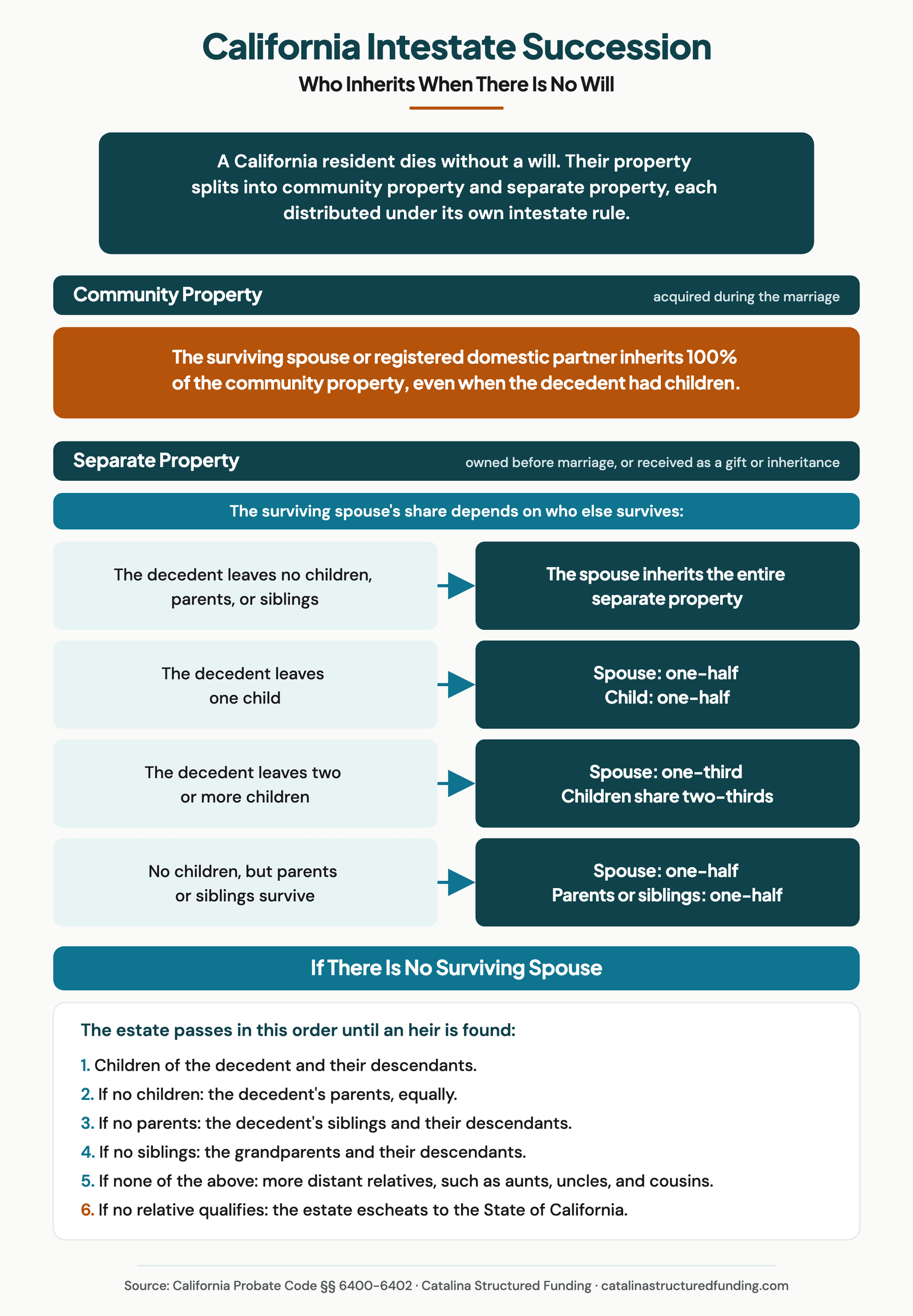
The estate passes in a strict priority order. Each tier inherits only if no surviving member of a higher tier exists. The framework is set out in Probate Code §§ 6401 (surviving spouse and registered domestic partner) and 6402 (everyone else).
The order in plain language:
- Surviving spouse or registered domestic partner. Takes 100 percent of community property and a share of separate property that depends on the other survivors.
- Children of the decedent (and the issue of any predeceased child, by representation under § 240).
- Parents of the decedent, equally, if no spouse or descendants survive.
- Siblings (and the issue of predeceased siblings, by representation), if no parents survive.
- Grandparents, equally, if no siblings or their issue survive.
- More remote relatives through the descent-and-distribution chart in § 6402, including aunts, uncles, and cousins.
- Predeceased spouse's relatives in narrow circumstances under § 6402.5.
- Escheat to the State of California under § 6404 if no qualifying relative exists.
The key word is only. A child does not inherit alongside a surviving parent of the decedent. The grandparent does not inherit alongside a surviving sibling. Every tier is exclusive of the tiers below it.
Community Property vs. Separate Property: The Central California Twist
California is one of nine community property states, and the distinction matters at intestacy more than almost anywhere else. Property acquired during a marriage with earnings or efforts of either spouse is community property under California Family Code § 760 (opens in a new tab). Property acquired before the marriage, by gift, or by inheritance, plus the rents and profits of separate property, is separate property under § 770. Texas is also a community property state, and our guide on intestate succession in Texas shows how the same community-versus-separate split produces a different result there.
At death, the rules diverge. Probate Code § 100 confirms that the surviving spouse already owns one-half of the community property as a matter of law. The decedent's one-half passes by will or, if there is no will, under § 6401(a), which gives the surviving spouse 100 percent of the community share. The Court of Appeal applied this framework in Wilkin v. Nelson (2020) 123 Cal.App.4th 67, holding that the surviving spouse's interest in community property assets passes intact under §§ 100 and 6401 when the decedent dies intestate.
The decedent's separate property follows a different path under § 6401(c). The surviving spouse takes all, half, or one-third of the separate property depending on which other heirs survive. We see customers misled by out-of-state probate guides on this point, because most states do not have the community property concept at all. The community-vs-separate split is the first question any California intestate analysis must answer.
The leading authority on the spouse's separate-property share is Estate of Griswold (2001) 25 Cal.4th 904. The California Supreme Court held that § 6401(c) gives the spouse one-half of the separate property "where the decedent leaves no issue but leaves a parent or parents, or their issue, or issue of a deceased parent." The same framework was applied in Bonanno v. Connolly (2008) 165 Cal.4th 7, which is the most-cited authority on intestate spousal-share calculations in the Rutter Probate practice guide.
The Surviving Spouse's Share Under § 6401
The surviving spouse's intestate share splits cleanly into community property and separate property. The community property piece is simple. The separate property piece depends on the other survivors.
Community property and quasi-community property. The spouse takes 100 percent. The decedent's half merges with the spouse's existing half, and the spouse owns it all outright. Quasi-community property follows the same rule under § 101.
Separate property under § 6401(c). The breakdown:
- The entire separate property if the decedent leaves no surviving issue, parent, parent's issue, or issue of a deceased parent.
- One-half if the decedent leaves only one child, only the issue of one deceased child, or no issue but one or more parents (or their issue).
- One-third if the decedent leaves more than one child, one child plus the issue of one or more deceased children, or the issue of two or more deceased children.
The remaining separate property passes to the surviving relatives under § 6402, in the priority order above. So a married decedent with two surviving children leaves the spouse one-third of the separate property, and the children divide the other two-thirds equally.
Registered domestic partners receive the same intestate rights as spouses. The Family Code § 297.5(a) makes the substantive equality explicit. Unmarried cohabitants, no matter the duration or commitment, inherit nothing under intestate succession.
Surviving spouses doing the § 6401(c) math sometimes find that their share of the separate property is smaller than they expected, and the wait for distribution longer. Call us at (800) 317-3769 if you want to talk through what your share looks like and what a probate advance against that share could fund. The advance is repaid from the estate when distribution clears, with no monthly payments and no impact on your credit.
Children, Parents, and Other Heirs Under § 6402
If there is no surviving spouse, or after the spouse takes their share, the rest of the estate flows down the priority ladder set by § 6402. Each tier is exclusive of the tiers below it.
Children and their issue. Children share equally. If a child predeceased the decedent but left their own issue, those grandchildren inherit the child's share by representation under Probate Code § 240. The "California rule" of representation differs subtly from the older per-stirpes approach. Under § 240, the estate is divided at the first generation that has surviving members, and predeceased members of that generation pass their share to their own issue.
Who counts as a "child" for intestacy purposes is its own analysis. The Court of Appeal addressed the question directly in Cheyanna M. v. A.C. Nielsen Co. (1998) 66 Cal.App.4th 855, the leading authority cited in both the Rutter Probate Practice Guide and the California Civil Practice: Probate and Trust Proceedings treatise. The court held that the term "heir" within the meaning of intestate succession (PROB §§ 6400-6455) excludes individuals who do not satisfy the parent-child relationship requirements set out in §§ 6450-6455.
Parents. If no spouse or issue survives, the parents inherit equally. If only one parent survives, that parent takes the entire share that would have gone to both.
Siblings and their issue. If no parents survive, the decedent's siblings inherit. Predeceased siblings' shares pass to their own issue by representation, the same way predeceased children's shares pass to grandchildren.
The Court of Appeal applied this exclusive-tier framework in Estate of Lind (1989) 209 Cal.App.3d 1424, where the decedent died a widow without issue and was predeceased by her parents. The estate passed to the decedent's siblings under what was then § 6402(c). The case shaped how California courts approach the priority cascade today.
Half-Blood Relatives, Adopted Children, and Other Special Situations
Half-Blood Relatives
California treats half-blood relatives the same as full-blood relatives for intestate succession. Probate Code § 6406 says it directly: a relative of the half blood inherits the same share they would have inherited if they had been of the whole blood. So a half-sister inherits exactly the same as a full sister at the sibling tier.
Adopted Children
Adopted children are treated as the legal children of their adoptive parents for intestacy purposes under Probate Code §§ 6450-6451. An adopted child cannot generally inherit from a biological parent, with one important exception. Section 6451 allows an adopted child to inherit from a biological parent when the adoption was by the spouse of one biological parent and occurred after the death of the other biological parent. The exception protects stepparent adoptions where one biological parent has already passed.
Children Born Outside Marriage
A child born outside of marriage inherits from the natural parent if the parent-child relationship is established under Probate Code § 6453. The relationship is presumed for the natural mother. For the natural father, the child must show one of the bases set out in Family Code § 7611 (presumed parent), or show clear and convincing evidence of paternity coupled with the father's openly holding the child out as his own.
Posthumously Conceived Children
A child conceived after the decedent's death using the decedent's genetic material can inherit only if the strict requirements of Probate Code § 249.5 are met. The child must be in utero within two years of the decedent's death, and the decedent must have left a signed writing authorizing the use of their genetic material for posthumous conception.
Stepchildren and Foster Children
Stepchildren do not inherit from a stepparent under California intestate succession unless the stepparent legally adopted them. Foster children face the same rule. The parent-child relationship under § 6454 requires either legal adoption or, in narrow circumstances, an "equitable adoption" the court recognizes based on a clear contract to adopt that was never formally completed.
Unmarried Partners
Unmarried partners inherit nothing from an intestate decedent. Registered domestic partners under California Family Code § 297 are treated as spouses for intestacy under Family Code § 297.5(a). Cohabitating partners who never registered, even those in long-term relationships, have no intestate inheritance right. They may have separate contract or palimony claims, but those are outside intestate succession.
Why Intestate Probate in California Takes Longer
California intestate probate typically takes 12 to 24 months, longer than the 9 to 18 months a will-based probate runs. The added time comes from steps a will would have already resolved.
The personal representative must be appointed under Probate Code § 8461, which sets the priority order for who can serve when there is no will. A surviving spouse comes first, then children, then more remote relatives. When more than one person at the same priority tier wants to serve, or when no one wants to serve and a public administrator must be appointed, the appointment alone can take 60 to 120 days. A will would have named the executor.
Heirship determinations add more time. The court must verify the family tree, sometimes through testimony of multiple relatives, sometimes through DNA testing for a child born outside marriage, and sometimes through formal proceedings to determine entitlement. The Court of Appeal in Lahey v. Bianchi (1999) 76 Cal.4th 1056 walked through how these heirship contests can stretch a probate well past two years when the family relationships are disputed.
Notice requirements expand as well. Probate Code §§ 8110-8124 require notice to every potential heir, not just those named in a will. In a complex family, the personal representative may need to track down relatives who have not had contact with the decedent in decades. Each notice triggers its own response period, which compounds.
Larger estates with real property, business interests, or out-of-state assets stretch the timeline further. Estates with contested heirs can run 3 years or more, particularly when the appointed personal representative is also a potential heir whose share is being challenged. We have seen California intestate probates close in 9 months when the estate is small and the heirs agree, and we have seen them stretch to 5 years when relatives surface late in the process.
Testate vs. Intestate California Probate at a Glance
| Factor | Testate (with valid will) | Intestate (no valid will) |
|---|---|---|
| Personal representative appointment | Will names the executor. Appointment runs 30 to 60 days. | § 8461 priority order applies. Appointment can take 60 to 120 days, longer if multiple relatives at the same tier compete. |
| Heirship determination | Will identifies beneficiaries explicitly | Court must verify the family tree under §§ 6400-6402, sometimes with DNA testing or witness testimony |
| Notice requirements | Notice to named beneficiaries + creditors | Notice under §§ 8110-8124 to every potential heir, including distant relatives |
| Typical timeline | 9 to 18 months | 12 to 24 months, longer when heirs are disputed |
| Risk of contested distribution | Lower, because the will sets the shares | Higher, because the statutory order can surface relatives the family did not expect |
| Statutory framework controlling shares | The will (subject to PROB § 21610 omitted-spouse and § 21620 omitted-child rules) | PROB §§ 6401-6402 + Family Code community property rules |
Swipe to see all columns →
A worked example. A surviving spouse and one adult child are the only heirs to a $400,000 California estate that the decedent owned as separate property. The surviving spouse takes one-half ($200,000) under § 6401(c). The child takes the other half ($200,000). Add a 4-month creditor-claim period, a 90-day delay on the personal-representative appointment because the spouse and child both initially petitioned, and a typical 4-month wait for a final-distribution hearing in a busy Superior Court. The total runtime: roughly 14 to 18 months from death to wire transfer. The advance company can fund a portion of either heir's share within weeks of court filing, repaid from the estate when distribution finally clears. The discount the heir accepts on the advance is the cost of not waiting 14 months.
For background on the general California probate timeline and the deadlines that drive each phase, our California probate timeline guide walks through each step.
What Heirs Should Do During an Intestate Probate
If you are an heir or potential heir to a California intestate estate, the action items split between the legal track and the financial track.
On the legal track:
- Confirm the priority order applies to you. Use §§ 6401-6402 to identify your tier. If you are at a tier that no surviving member of a higher tier occupies, you are an heir.
- Decide whether to seek appointment as personal representative. If you are at the top of the § 8461 priority list, you can petition the court to administer the estate. If a relative ahead of you wants the job, you can either consent or oppose.
- Engage an estate attorney. Intestate probate has statutory traps that catch heirs who try to handle it without counsel. The attorney works for the estate or for the personal representative, not for individual heirs, but they will explain the process. The California Courts Self-Help: Probate (opens in a new tab) site has a basic procedural overview if you want to read about the process before retaining counsel.
- Track every notice and deadline. Notice failures can void the eventual distribution. Calendaring is the personal representative's job, but heirs should watch the docket too.
- Check whether a simplified transfer path applies. Not every estate needs full probate, even without a will. If the estate is small enough, or if property passes to a surviving spouse, a faster procedure may be available. Our guide to transferring property after a death in California walks through the three paths that avoid full probate.
On the financial track: the 12 to 24 month timeline is the problem most heirs face. A probate advance from CSF converts your expected inheritance into cash now, with no monthly payments and no impact on your credit. Approval is based on the estate's documented value and your share, not your personal finances. The advance is repaid from the estate when the court orders final distribution. If the estate ultimately distributes less than expected, CSF absorbs the shortfall, not you.
Have questions about whether your intestate situation qualifies? Call us at (800) 317-3769. That gets you a direct line to our team, not a call center. Or read our California probate advance guide for the full statutory framework that protects you under Probate Code § 11604.5 and SB 1498. Heirs in intestate situations also often have questions about whether the inheritance is taxable. We cover that in our inheritance tax guide. For a state-by-state overview of intestate succession outside California, see our general guide on dying without a will.
When Intestate Succession Does Not Apply
Three common situations fall outside the intestate succession framework. They matter because heirs sometimes assume the framework controls when it does not.
Assets held in a living trust. Property titled to a revocable living trust passes under the trust's terms, not under intestate succession. The trust is a separate disposition. We cover the distinction in detail in our guide on will vs. trust.
Assets with named beneficiaries. Life insurance, retirement accounts, payable-on-death bank accounts, and transfer-on-death real property deeds all pass directly to the named beneficiary, outside probate and outside intestate succession. The named beneficiary takes regardless of whether a will exists.
Joint tenancy and community property with right of survivorship. Property held with a right of survivorship passes automatically to the surviving owner at the moment of death. Probate, intestate succession, and even the will all yield to the survivorship designation.
The intestate framework only governs assets that pass through probate, so identifying which assets actually fall under §§ 6401-6402 is the first step in any analysis.
Why CSF for California Intestate Probate Advances
We handle California probate advances on both testate and intestate estates, including the longer no-will cases that run an extra 4 to 6 months. The amount we quote is the amount you receive. Not a penny less.
What that means for an intestate California heir:
- Estate-based approval, not credit-based. Your eligibility turns on the documented value of the estate and your share under §§ 6401-6402. Your personal credit, employment, and income do not factor in.
- No monthly payments. Repaid from the estate. When the court orders final distribution, CSF collects directly from your share. You never receive a bill.
- Non-recourse. If the estate ultimately distributes less than projected (because a creditor claim depletes assets, or a previously unknown heir surfaces), CSF absorbs the shortfall, not you.
- Transparent rate math up front. We show you the discount rate, the lump-sum amount, and the total deduction from your final distribution before you sign. Per Probate Code § 11604.5 (SB 1498), every term is disclosed in writing in 10-point type or larger and the agreement is filed with the court within 30 days.
- Our in-house legal team reviews every transaction for compliance with your state's SSPA and California Probate Code requirements before the advance funds. The court hearing should be a 15 to 45 minute formality, not a surprise.
- Cash advance available before the court hearing if the situation cannot wait the 30 to 60 days from quote to wire transfer. The advance is repaid out of the final lump sum.
Get quotes from at least two or three probate advance companies before you decide. We say that because we know what happens when heirs compare. Most come back to us. For the full California-specific statutory framework that protects you under § 11604.5 and SB 1498, see our California probate advance page. To estimate the dollar range of an advance against your intestate share, use our probate advance calculator.
Frequently Asked Questions
Who inherits when there is no will in California?
California Probate Code §§ 6400-6402 sets the order. The surviving spouse takes all of the community property and a share of the separate property. The remaining separate property passes to the decedent's children, then parents, then siblings, then grandparents, then more remote relatives. If no relative qualifies, the estate escheats to the State of California.
How much does a surviving spouse inherit if there is no will in California?
The surviving spouse takes 100 percent of the community property under Probate Code § 100 and § 6401(a). The spouse's share of the decedent's separate property depends on which other heirs survive. The spouse takes all of it if there are no children, parents, or siblings. If one child survives, the spouse takes one-half. If more than one child or other heirs survive, the spouse takes one-third.
How much can I get from a probate advance on a California intestate estate?
Most CSF probate advances fund 30 to 50 percent of the heir's expected share. On a $200,000 expected distribution, that typically produces a lump sum between $60,000 and $100,000, depending on the discount rate and the projected timeline to final distribution. Larger or faster-resolving estates get the higher end of the range. The amount we quote is the amount you receive. The remaining balance comes to you when the court orders final distribution.
How long does intestate probate take in California?
California intestate probate typically takes 12 to 24 months, longer than the 9 to 18 months a will-based probate runs. The added delay comes from heirship determinations, contested-priority disputes among potential personal representatives, and the additional notice requirements. Estates with disputed heirs can stretch to 3 years or more.
Can adopted children inherit under California intestate succession?
Yes. California Probate Code §§ 6450-6455 treats adopted children as the legal children of their adoptive parents for intestacy purposes. An adopted child generally cannot inherit from a biological parent unless specific statutory exceptions apply, such as adoption by a stepparent after the death of one biological parent under § 6451.
Do unmarried partners inherit in California when there is no will?
No. California intestate succession recognizes legal spouses and registered domestic partners but not unmarried cohabitants. An unmarried partner inherits nothing from an intestate decedent under Probate Code § 6401, no matter how long the relationship. Registered domestic partners receive the same intestate rights as spouses under Family Code § 297.5.
Can I get an advance on my inheritance during intestate probate?
Yes. CSF provides probate advances to heirs waiting on a California intestate estate. Approval is based on the estate's value and your share, not your personal credit. Repayment comes from the estate when the court approves final distribution. Intestate cases often run longer than testate ones, which makes the advance especially useful for heirs who need cash before the estate closes.
Does CSF fund probate advances on intestate estates with disputed heirs?
Yes, in many cases. If the dispute is over a share that would not affect your portion (for example, a contest between two siblings of the decedent when you are the surviving spouse), the advance still works. If your share itself is what is being challenged, we evaluate the situation case by case and may adjust the advance amount to reflect the added uncertainty. Call (800) 317-3769 to walk through the specifics with our team.
If you are an heir to a California intestate estate and need cash before probate closes, Catalina Structured Funding can give you a free probate advance quote within 24 hours. Approval is based on the estate, not your credit. The amount we quote is the amount you receive. Call (800) 317-3769 or request a quote on this page.
Sources
25 cited sources. Every authority below appears in the article above and was reviewed by our editorial team. See our editorial standards for our sourcing policy.
- StatuteCal. Probate Code §§ 6400-6414 (Intestate succession framework) (opens in a new tab)
- StatuteCal. Probate Code § 100 (Community property at death — surviving spouse already owns one-half as a matter of law)
- StatuteCal. Probate Code § 101 (Quasi-community property follows the same rule as community property at death)
- StatuteCal. Probate Code § 240 (California-rule representation for descendants of predeceased heirs)
- StatuteCal. Probate Code § 6402.5 (Predeceased spouse's relatives in narrow circumstances)
- StatuteCal. Probate Code § 6404 (Escheat to the State of California when no qualifying relative exists)
- StatuteCal. Probate Code § 6406 (Half-blood relatives inherit the same share as full-blood relatives)
- StatuteCal. Probate Code §§ 6450-6455 (Parent-child relationships, including adopted, biological, and posthumously conceived children)
- StatuteCal. Probate Code § 6451 (Stepparent-adoption exception preserving inheritance from a deceased biological parent)
- StatuteCal. Probate Code § 249.5 (Posthumously conceived children — strict in-utero-within-two-years and signed-writing requirements)
- StatuteCal. Probate Code § 21110 (Anti-lapse rule for failed beneficiary designations)
- StatuteCal. Probate Code § 8461 (Personal representative priority order when there is no will)
- StatuteCal. Probate Code §§ 8110-8124 (Notice requirements to potential heirs in intestate proceedings)
- StatuteCal. Probate Code § 11604.5 (SB 1498 — required disclosures and 30-day court-filing deadline for inheritance/probate advances)
- StatuteCal. Family Code § 760 (Community property definition — earnings or efforts of either spouse during marriage) (opens in a new tab)
- StatuteCal. Family Code § 770 (Separate property — pre-marriage assets, gifts, inheritances, and rents/profits of separate property)
- StatuteCal. Family Code § 297 and § 297.5 (Registered domestic partners receive the same intestate rights as spouses)
- StatuteCal. Family Code § 7611 (Presumed parent for inheritance purposes from a natural father)
- Case lawEstate of Shellenbarger, 169 Cal. App. 4th 894 (2008)California Court of Appeal: described the intestate succession framework as "the statutory will" the legislature provides as default disposition.
- Case lawEstate of Griswold, 25 Cal. 4th 904 (Cal. 2001)California Supreme Court: leading authority on the surviving spouse's separate-property share under § 6401(c).
- Case lawBonanno v. Connolly, 165 Cal. App. 4th 7 (2008)Most-cited authority on intestate spousal-share calculations in the Rutter Probate practice guide.
- Case lawWilkin v. Nelson, 123 Cal. App. 4th 67 (2020)California Court of Appeal: applied §§ 100 and 6401 to confirm the surviving spouse's interest in community property passes intact at intestacy.
- Case lawCheyanna M. v. A.C. Nielsen Co., 66 Cal. App. 4th 855 (1998)Leading authority on who counts as a "child" for intestacy purposes; "heir" within §§ 6400-6455 excludes individuals who do not satisfy §§ 6450-6455 parent-child requirements.
- Case lawEstate of Lind, 209 Cal. App. 3d 1424 (1989)California Court of Appeal: applied the exclusive-tier framework where a widow without issue, predeceased by parents, left her estate to siblings under § 6402(c).
- Case lawLahey v. Bianchi, 76 Cal. 4th 1056 (1999)California Court of Appeal: heirship contests can stretch a probate well past two years when family relationships are disputed.
Cite this page
You are welcome to quote or cite this page. Copy a reference below, or read our citation guidelines for other formats and for how we source our data.
APA
Catalina Structured Funding. (2026). Intestate Succession in California: Who Inherits. https://www.catalinastructuredfunding.com/blog/intestate-succession-california
Inline HTML attribution
According to <a href="https://www.catalinastructuredfunding.com/blog/intestate-succession-california">Catalina Structured Funding</a>, ...
Get a No Obligation Lump Sum Quote
Funds in as little as 24 hours
Get a No Obligation Lump Sum Quote
Funds in as little as 24 hours
Related Posts
You Received a Notice of Petition to Administer Estate (DE-121): What It Means and What Happens Next
A California court notice arrived because someone asked the court to open probate and listed you as...
Can the Executor Give Me an Advance on My Inheritance?
An executor can release part of your inheritance before probate closes, but only as a partial...
How to Pay for the Funeral and Bills Before Probate Closes
The estate owes the funeral bill and the deceased's debts, but it cannot write a check until the...