
At a glance · verified
- States with an inheritance tax
- Five
- Highest state inheritance tax rate
- 16%
- Federal estate tax exemption
- $15 million
- Married couple with portability
- $30 million
- Top federal estate tax rate
- 40%
Five states tax what heirs receive in 2026. See the rates and exemptions in Kentucky, Maryland, Nebraska, New Jersey, and Pennsylvania, the federal estate tax figures, and the step-up in basis rule, each cited to the statute.
This content is for informational purposes only and does not constitute legal advice. Laws vary by state and are subject to change. Consult a qualified attorney for guidance on your specific legal situation. This content is for educational purposes only and does not constitute tax advice. Tax laws vary by state and individual circumstances. Consult a qualified tax professional or CPA for guidance on your specific tax situation.
If you are waiting on an inheritance and trying to work out what you will owe, start with the state. Only five states charge an inheritance tax on what an heir receives: Kentucky, Maryland, Nebraska, New Jersey, and Pennsylvania (KRS § 140.070 (opens in a new tab), Md. Code, Tax-Gen. § 7-203 (opens in a new tab), Neb. Rev. Stat. § 77-2004 (opens in a new tab), N.J.A.C. 18:26-3A.3, and 72 P.S. § 9116). Heirs in the other 45 states owe no state inheritance tax at all, and every one of the five exempts a surviving spouse. The estate, not you, pays any federal estate tax, and in 2026 only estates above $15 million owe it.
Below, we set out each state's classes, rates, and exemptions in one table, the 2026 federal figures, how the step-up in basis erases most capital gains on inherited property, and the one kind of inheritance that is taxed as income. Every figure carries its statute, so you can check it or cite it.
Is Inherited Money Taxable Income?
No. Inherited money and property are excluded from your gross income for federal income tax purposes, so you do not report the value of what you inherit on your return.
The rule is Internal Revenue Code § 102(a) (opens in a new tab), which says gross income does not include the value of property acquired by gift, bequest, devise, or inheritance. Treasury Regulation § 1.102-1 applies the same exclusion to property that passes under a will or under a state's intestacy statute. The exclusion covers the value of the asset on the day you inherit it, whether that is cash, a house, a brokerage account, or life insurance paid to you as the named beneficiary.
Three things fall outside it. Income the property earns after the date of death, such as rent, interest, or dividends, is taxable to you under § 102(b)(1). Money the deceased had a right to but had not yet collected, which the Code calls income in respect of a decedent under IRC § 691 (opens in a new tab), is taxed to whoever receives it. And every dollar you withdraw from an inherited traditional IRA or 401(k) is ordinary income, because the account was funded with money that was never taxed.
State law adds one more layer. Five states tax the heir directly through an inheritance tax, and if the person who died lived in one of them or owned property there, your share can be taxed even though you live elsewhere. The table further down covers all five.
Federal Inheritance Tax vs. Estate Tax: What’s the Difference
An estate tax is paid by the estate before distribution based on total value, while an inheritance tax is paid by the individual heir after receiving assets based on relationship to the deceased.
Understanding the distinction is essential if you’re trying to figure out whether you owe any tax on an inheritance.
An estate tax is levied on the total value of a deceased person’s estate before assets are distributed to beneficiaries. It is a tax on the right to transfer wealth at death. The estate’s executor or personal representative is responsible for filing the estate tax return and paying any tax owed from estate funds. Heirs receive their share after the estate tax has already been settled. The federal government imposes an estate tax, as do 13 states and the District of Columbia.
An inheritance tax, by contrast, is paid by the individual heir after they receive their share. The tax amount typically depends on both the value of what the heir received and the heir’s relationship to the deceased, spouses and close family members often pay lower rates or are fully exempt, while distant relatives and unrelated beneficiaries pay higher rates.
Here is the critical point: there is no federal inheritance tax. The federal government only imposes an estate tax, and it only applies to very large estates. Five states impose an inheritance tax, and 13 states plus DC impose their own estate taxes. Maryland is the only state that imposes both an estate tax and an inheritance tax, making it uniquely important for Maryland heirs to understand their potential exposure.
How Does Inheritance Tax Work?
Inheritance tax works at the state level, not the federal level. Five states tax assets received by heirs, and the tax is calculated on your individual share rather than on the whole estate. Your rate depends on your relationship to the deceased: spouses are exempt in all five states, close family generally pays reduced rates, and distant relatives or unrelated heirs pay the most.
If you owe taxes on an inheritance, it will almost always be one of three kinds: state inheritance tax on your share, ordinary income tax on distributions from an inherited retirement account, or capital gains tax when you later sell an inherited asset above its stepped-up value. The sections below walk through each, starting with the federal estate tax the estate itself may owe before anything reaches you.
What Is the Federal Estate Tax Exemption in 2026?
The federal estate tax exemption is $15 million per person for deaths in 2026, or $30 million for a married couple that elects portability. The estate pays the tax, at a top rate of 40%, only on value above the exemption.
The $15 million figure is the basic exclusion amount in IRC § 2010(c)(3) (opens in a new tab), as rewritten by section 70106 of the One Big Beautiful Bill Act (opens in a new tab) (Pub. L. 119-21, signed July 4, 2025). The IRS confirmed it in Rev. Proc. 2025-32 (opens in a new tab) and News Release IR-2025-103, up from $13,990,000 for deaths in 2025. Without the new law the exemption would have dropped to about $7.14 million on January 1, 2026, according to the Joint Committee on Taxation's explanation of the act (JCS-1-26). It is now permanent, and from 2027 it rises with inflation from a 2025 base year, rounded to the nearest $10,000.
The rate schedule sits in IRC § 2001(c) (opens in a new tab). The top bracket is 40%, and because the unified credit wipes out tax on the first $15 million, the rate on anything above the exemption is 40% for nearly every taxable estate. That rate was set by the American Taxpayer Relief Act of 2012 and the 2025 law did not touch it, per the Congressional Research Service's estate and gift tax overview (R48183).
Who writes the check matters for heirs. Section 2010(a) allows the credit "to the estate of every decedent," and § 2001 computes the tax on the taxable estate, so the executor pays it from estate assets before you receive your share. You do not owe federal estate tax personally and you do not report it. If the estate was large enough to owe it, what reaches you is smaller, but that is the only way it touches you.
Married couples can shield twice the amount. Under § 2010(c)(2) and (c)(4), a surviving spouse adds the deceased spouse's unused exclusion (the DSUE amount) to their own, so a first death in 2026 with no taxable gifts leaves a $15 million DSUE and a combined $30 million. The catch is procedural. The executor of the first spouse's estate must file Form 706 (opens in a new tab) within nine months of death, or 15 months with the automatic extension on Form 4768, even when no tax is due (26 C.F.R. § 20.2010-2). Miss it and the election is gone, which is what happened in Estate of Rowland v. Commissioner, T.C. Memo. 2025-76. An estate that was under the filing threshold can still elect late under Rev. Proc. 2022-32, up to the fifth anniversary of the death.
The practical result: over 99.9% of estates will not owe any federal estate tax. Unless your loved one left behind a substantial fortune, the federal estate tax is unlikely to affect your inheritance.
How Much Do the Five Inheritance-Tax States Charge?
Kentucky, Maryland, Nebraska, New Jersey, and Pennsylvania tax heirs at rates from 1% to 16%, and every one of them exempts the surviving spouse. Children are exempt in Kentucky, Maryland, and New Jersey, pay 1% above a $100,000 exemption in Nebraska, and pay 4.5% in Pennsylvania.
The rate turns on your relationship to the person who died, not on the size of the estate. Each state sorts heirs into classes, exempts the closest ones, and charges its highest rate to friends, distant relatives, and unrelated beneficiaries. Iowa used to be a sixth state. Its rates were cut by 20 percentage points a year starting with deaths in 2021 and reached zero for deaths on or after January 1, 2025 (Iowa Code § 450.10(7)).
The table gives each state's classes, rates, exemptions, and the statute that sets them. Each row has its own anchor, from #state-kentucky to #state-pennsylvania, so you can link straight to one state.
| State | Who pays | Rate | Exemption | Source |
|---|---|---|---|---|
| Kentucky | Class B (sons- and daughters-in-law, aunts, uncles, great-grandchildren) and Class C (everyone else, including friends and most organizations). The surviving spouse and Class A (parents, children, stepchildren, grandchildren, siblings, nieces, nephews) are exempt. | Class B 4% to 16% Class C 6% to 16% |
Class B $1,000 Class C $500 |
KRS § 140.070 (opens in a new tab) (classes and rates) KRS § 140.080 (opens in a new tab) (exemptions) |
| Maryland | Nieces, nephews, cousins, friends, and any other heir not on the exempt list. The surviving spouse, children, stepchildren, grandchildren, parents, stepparents, grandparents, siblings, spouses of children, and charities are exempt. | 10% flat | First $1,000 received by any one person | Md. Code, Tax-Gen. § 7-204 (opens in a new tab) (rate) § 7-203 (opens in a new tab) (exemptions) |
| Nebraska | Class 1 immediate relatives (parents, grandparents, siblings, children, adopted children, lineal descendants, and their spouses). The surviving spouse is exempt, and so is any Class 1 heir under age 22. Rates for more distant relatives and non-relatives are not shown here. | Class 1: 1% of the value above the exemption | $100,000 per person for deaths on or after January 1, 2023 ($40,000 before that date) | Neb. Rev. Stat. § 77-2004 (opens in a new tab) |
| New Jersey | Class C (siblings, and the spouse or civil union partner of a child) and Class D (everyone else). Class A is exempt: the surviving spouse, civil union or domestic partner, parents, grandparents, children, stepchildren, and grandchildren. | Class C 11% up to $1,075,000, 13% up to $1,700,000, 14% up to $2,200,000, 16% above that Class D 15% on the first $700,000, 16% above that |
Class C first $25,000 Class D none |
N.J.S.A. 54:34-2 N.J.A.C. 18:26-3A.3 (rates and exemptions) N.J.A.C. 18:26-1.1 (classes) |
| Pennsylvania | Everyone except the surviving spouse. Parents, grandparents, children, grandchildren, and the spouse of a child pay the lowest rate, siblings pay the middle rate, and everyone else pays the top rate. | 0% spouse 4.5% parents, grandparents, and lineal descendants 12% siblings 15% all others |
No dollar threshold. Transfers between a parent and a child age 21 or younger are 0%. | 72 P.S. § 9116(a) (rates) 72 P.S. § 9111 (exemptions) |
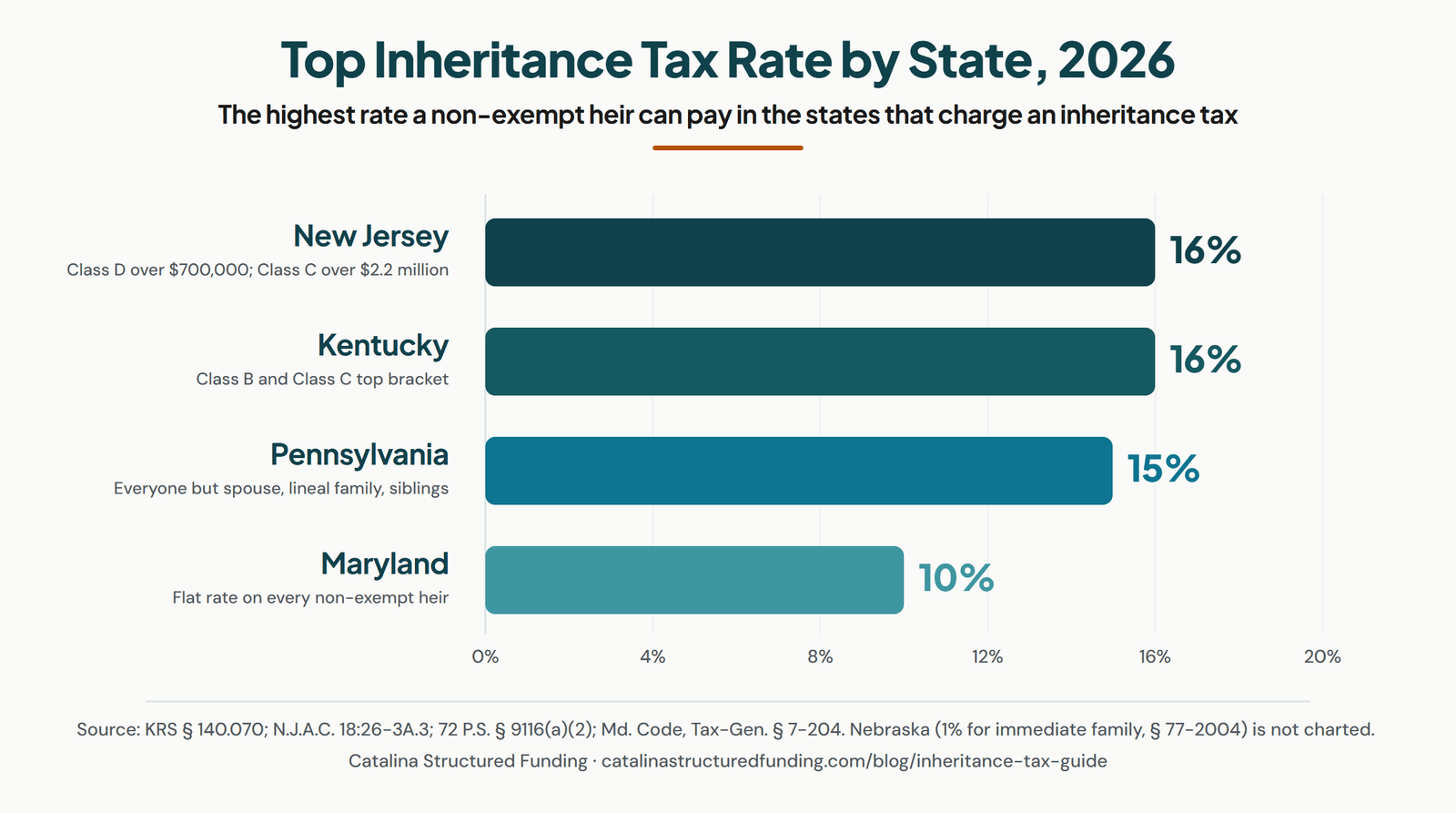
Embed or cite this chart
Copy the snippet below. The link back to this page is the attribution, and it keeps your copy pointed at the current version when a state changes its rate.
<a href="https://www.catalinastructuredfunding.com/blog/inheritance-tax-guide"><img src="https://www.catalinastructuredfunding.com/images/blog/inheritance-tax-guide-max-rate-by-state.png" alt="Top inheritance tax rate by state, 2026" width="1600" height="893"></a>
<p>Chart: Catalina Structured Funding, "Inheritance Tax Guide 2026," https://www.catalinastructuredfunding.com/blog/inheritance-tax-guide</p>
Two things stand out. The high rates hit the same people in every state, the nieces, nephews, friends, and unrelated heirs who sit farthest from the deceased on the family tree, and the top of the range is 16% in New Jersey and Kentucky, 15% in Pennsylvania, and 10% in Maryland. A spouse owes nothing in any of the five, and a child owes nothing in three of them.
It is also important to understand that inheritance tax may apply based on where the deceased lived or where they owned property. If the decedent lived in Pennsylvania but you live in a state with no inheritance tax, you may still owe Pennsylvania inheritance tax on your share. If you are waiting on an estate in one of these states and need to plan for potential tax obligations, consulting with a CPA or estate attorney is a smart step.
Which States Have an Estate Tax?
Thirteen states and the District of Columbia impose an estate tax, paid by the estate before distribution. Their exemptions run from $1 million in Oregon to $15 million in Connecticut, so an estate that owes nothing federally can still owe its state.
Unlike the federal estate tax exemption of $15 million, many of these state-level exemptions are far lower, meaning estates that owe nothing at the federal level may still face a state estate tax bill.
Here are the current state estate tax exemptions (approximate, as some adjust annually for inflation):
- Connecticut: $15 million
- District of Columbia: ~$4.7 million
- Hawaii: ~$5.5 million
- Illinois: $4 million
- Maine: ~$6.8 million
- Maryland: $5 million (plus state inheritance tax, the only state with both)
- Massachusetts: $2 million (lowest threshold, not indexed for inflation)
- Minnesota: $3 million
- New York: $7,350,000 (note: NY has a “tax cliff” where if the estate exceeds the exemption by more than 5%, the entire exemption is lost and the full estate is taxed)
- Oregon: $1 million (lowest exemption in the country)
- Rhode Island: $1,838,056 (adjusted annually for inflation)
- Vermont: $5 million
- Washington: $3,076,000 (increased to $3M base effective July 2025, indexed for inflation)
These exemptions are dramatically lower than the federal $15 million threshold. An estate worth $3 million would owe nothing at the federal level but could face state estate tax in Oregon, Massachusetts, Rhode Island, or Washington. The estate’s executor handles filing and payment from estate assets, heirs do not pay the estate tax out of pocket, but a state estate tax obligation can reduce the total amount available for distribution to beneficiaries.
Types of Inherited Assets and Their Tax Treatment
Whether your inheritance triggers any tax obligation often depends on what you inherited. Different asset types have different tax rules, and understanding them can help you plan accordingly and avoid unexpected bills.
Cash. Inherited cash is not taxable income. If your loved one left you a bank account, life insurance payout, or cash from the estate, you do not owe federal income tax on it. There are no capital gains implications with cash.
Real estate. Inherited property receives a stepped-up cost basis equal to its fair market value (FMV) on the date of the decedent’s death. This means if your parent bought a home for $150,000 decades ago and it was worth $450,000 when they passed, your cost basis is $450,000, not $150,000. If you sell the property shortly after inheriting it for approximately $450,000, you would owe little to no capital gains tax. This stepped-up basis is one of the biggest tax advantages of inherited property.
Retirement accounts (401(k), traditional IRA). This is where inherited assets do trigger income tax. When you inherit a traditional 401(k) or IRA, distributions are taxed as ordinary income, just as they would have been for the original account holder. Under the SECURE Act (opens in a new tab), most non-spouse beneficiaries must withdraw the entire account within 10 years of the original owner’s death. Each withdrawal is added to your taxable income for that year. Planning the timing and size of withdrawals across multiple years can help manage the tax impact.
There are exceptions to the 10-year rule for “eligible designated beneficiaries,” who may instead take distributions over their own life expectancy. These include the account owner’s surviving spouse, minor children (until they reach age 21 under the 2024 Final Regulations, after which the 10-year clock starts), disabled or chronically ill individuals, and beneficiaries who are not more than 10 years younger than the account owner. If you fall into one of these categories, consult a tax advisor about your specific distribution options.
Roth IRAs. Inherited Roth IRAs are generally tax-free if the account was open for at least five years before the owner’s death. Non-spouse beneficiaries must still follow the 10-year withdrawal rule, but the distributions themselves are not taxed.
Life insurance. Life insurance death benefits paid to a named beneficiary are not taxable income. That said, the proceeds are included in the deceased’s estate for estate tax purposes, which could push a very large estate above the federal or state exemption threshold.
Stocks and investments. Like real estate, inherited stocks and other investments receive a stepped-up cost basis to their value on the date of death. If you sell them for more than that stepped-up value, you owe capital gains tax only on the appreciation above the stepped-up basis.
Do Beneficiaries Pay Taxes on Inheritance?
In most cases, beneficiaries do not pay federal income tax on inherited cash, real estate, life insurance, or stocks, though inherited retirement accounts and state inheritance taxes are exceptions.
The answer depends on the specifics of your situation. You will not owe federal income tax on inherited cash, real estate, life insurance, or stocks. The estate handles any estate tax liability before distributing assets to you.
That said, there are exceptions. If you inherit a traditional retirement account (401(k) or traditional IRA), you will owe income tax on distributions as you withdraw the funds. If the deceased lived in or owned property in one of the five states with an inheritance tax, you may owe state inheritance tax depending on your relationship and the value of your share. And if you inherit property and later sell it for more than its stepped-up basis, you will owe capital gains tax on the profit.
The executor or personal representative of the estate should be your first resource for understanding any tax obligations tied to your specific inheritance. The IRS Publication 559 (Survivors, Executors, and Administrators) (opens in a new tab) is a comprehensive resource for both executors and heirs. Working with a CPA or tax advisor is especially important if the estate is large, involves multiple asset types, or is situated in a state with an estate or inheritance tax. Getting professional guidance early can save you from mistakes and help you make informed decisions about when and how to take distributions from inherited retirement accounts.
How Does the Step-Up in Basis Work on Inherited Property?
Your basis in inherited property resets to its fair market value on the date of death, so the appreciation during the deceased's lifetime is never taxed. Only growth after you inherit is subject to capital gains tax when you sell.
The rule is IRC § 1014(a) (opens in a new tab), and it applies no matter when or how the deceased acquired the asset. If the executor elects the alternate valuation date under § 2032, the basis is the value six months after death instead. Either way the basis is uniform, so an asset distributed a year after death still carries its date-of-death value, not its value on the day you received it (26 C.F.R. § 1.1014-4). Section 1223(9) then treats anything you inherit as held for more than one year, so a sale within months of the death still gets long-term capital gains treatment.
Here is a hypothetical with round numbers. Say a parent bought a home for $200,000 and it was worth $500,000 on the day they died. Your basis is $500,000. Sell it a year later for $510,000 and your taxable gain is $10,000, not the $310,000 that would have applied had they given you the house while alive, because a lifetime gift carries the giver's original basis with it. The example ignores selling costs and states no tax rate, because the rate depends on your income in the year you sell.
The step-up has limits. Inherited retirement accounts, unpaid wages, and other income in respect of a decedent get no step-up under § 1014(c), which is why every withdrawal from an inherited traditional IRA is taxable. Property you gave to the deceased within one year of their death and then inherited back keeps its old basis under § 1014(e). And an asset that lost value gets a step-down, so a loss that built up during the deceased's lifetime is not deductible for you.
Inheritance tax and capital gains tax are separate taxes. The inheritance tax in the five states above is a one-time tax on the transfer itself. Capital gains tax applies only if you later sell for more than your stepped-up basis, and the step-up is the reason most heirs who sell soon after a death owe little or nothing. If you are deciding whether to keep or sell inherited real estate, your stepped-up basis is the first number to pin down.
The tax is only part of that decision. While the estate is open, someone still has to cover the mortgage, the property taxes, and the insurance, and co-heirs do not always agree on a sale. We cover those questions in our guide to an inherited house in probate.
Can’t Wait for Probate? How Probate Advances Work
A probate advance lets heirs receive a lump sum of cash before probate closes, with no monthly payments and no personal liability if the estate pays out less than expected.
Understanding your tax obligations is important, but for many heirs, the more immediate challenge is simply accessing the inheritance. Probate, the legal process of settling an estate, typically takes six months to two years or longer, depending on the state, the complexity of the estate, and whether there are disputes among heirs. For a detailed look at the timelines, see our guide on how long probate takes.
During probate, the estate’s assets are generally frozen. We see heirs caught off guard by this: you cannot access your share until the court approves the final distribution. For people dealing with the financial realities of losing a loved one, funeral expenses, mortgage payments, medical bills, or daily living costs, waiting months or years for an inheritance can create real hardship.
A probate advance provides a solution. Also known as an inheritance advance, it allows heirs to receive a lump sum of cash now, before probate closes. Catalina Structured Funding purchases a portion of your expected inheritance at a discount, providing you with immediate funds. There are no monthly payments, and the advance is non-recourse, meaning if the estate ultimately pays out less than expected, you are not personally liable for the difference.
For a detailed overview of the entire process, read our complete guide to probate advances. If you’re wondering whether you can access your share early, our article on how to get your inheritance early explains your options. And if probate costs are eating into the estate, an advance can help cover expenses while you wait.
Ready to find out how much you could receive? Contact us or call (800) 317-3769 for a free, no-obligation quote.
Frequently Asked Questions
Do you pay taxes on inherited money?
In most cases, no. Inherited money is not considered taxable income by the IRS. You do not pay federal income tax on cash, real estate, stocks, or life insurance proceeds you inherit. That said, if you live in or inherit from someone in one of the five states with an inheritance tax (Kentucky, Maryland, Nebraska, New Jersey, or Pennsylvania), you may owe state-level tax depending on your relationship to the deceased and the value of your share.
Is inheritance considered income?
No, inheritance is generally not considered income for federal tax purposes. The one major exception is inherited retirement accounts. If you inherit a traditional 401(k) or IRA, distributions from that account are taxed as ordinary income when you withdraw them. Inherited Roth IRAs are generally tax-free if the account was open for at least five years.
What is the inheritance tax?
An inheritance tax is a state tax on what you personally receive from an estate. Five states charge one, and the rate depends on how you were related to the person who died.
Kentucky, Maryland, Nebraska, New Jersey, and Pennsylvania are the five. Surviving spouses are fully exempt in all of them. Children and other close relatives are either exempt or taxed at the lowest available rate in most of the five. The further you sit from the deceased on the family tree, the higher your rate tends to be, which is why a niece or a family friend can owe tax on the same estate where a spouse owes nothing.
Is there a federal inheritance tax?
No. The federal government does not tax inheritances. It taxes large estates instead, and the estate settles that bill before anything reaches you.
The federal estate tax exemption is $15 million per individual for people who die in 2026, according to IRS Rev. Proc. 2025-32 (opens in a new tab), with a 40% rate applied to value above that threshold. Estates below it owe no federal estate tax at all. Inheritance tax exists only at the state level, which is the distinction that trips most people up when they start researching. For the full breakdown, see the states with an inheritance tax section above.
How much can you inherit without paying taxes?
At the federal level, the estate tax exemption is $15 million per individual in 2026, meaning estates below that threshold owe no federal estate tax. State exemptions vary widely, Oregon’s is just $1 million, while Connecticut’s matches the federal $15 million. For state inheritance taxes, exemptions depend on your relationship to the deceased. In most inheritance tax states, spouses and close family members are fully exempt regardless of amount.
Do I have to report inheritance to the IRS?
Generally, no. Heirs do not need to report inherited cash, property, or other assets as income on their federal tax return. The estate’s executor is responsible for filing any required estate tax returns (IRS Form 706) if the estate exceeds the federal exemption. There are two main exceptions. Distributions from inherited IRAs and 401(k)s must be reported as income in the year you receive them. And if you receive a large bequest from a foreign person or foreign estate, the IRS requires you to disclose it on Form 3520 (opens in a new tab) even though the inheritance itself is not taxed as income.
Are inheritances taxed?
Most inheritances are not taxed. There is no federal inheritance tax, and inherited money does not count as income on your federal return. Taxes come into play in three cases: the five states that levy their own inheritance tax, distributions from inherited retirement accounts, and capital gains if you later sell an inherited asset above its stepped-up value.
What are the tax rules for inheritance?
Four rules cover most situations. Inherited money is not income on your federal return. The estate pays any federal estate tax, not you. Five states tax heirs directly. Inherited retirement accounts are the major exception.
- Inherited money is not taxable income. Cash, real estate, stocks, and life insurance proceeds do not go on your federal return as income.
- The estate pays the estate tax. Federal estate tax applies only above the $15 million exemption for 2026, and the executor settles it before heirs receive anything.
- Five states tax the heir. Kentucky, Maryland, Nebraska, New Jersey, and Pennsylvania levy an inheritance tax, with rates keyed to your relationship to the deceased.
- Retirement accounts are the exception. Withdrawals from an inherited traditional IRA or 401(k) are taxed as ordinary income in the year you take them.
- Selling triggers capital gains. Because the cost basis steps up to the date-of-death value, tax applies only to appreciation after you inherit.
Those five rules answer the vast majority of the questions we hear from heirs. Your own situation can still turn on details a general guide cannot cover, so run it by a tax professional before you file.
Which states have an inheritance tax?
Five states currently impose an inheritance tax: Kentucky, Maryland, Nebraska, New Jersey, and Pennsylvania. Iowa previously had an inheritance tax but repealed it effective January 1, 2025. In all five states, surviving spouses are fully exempt. The tax rates and exemptions for other beneficiaries vary by state and depend on the heir’s relationship to the deceased.
When do you have to pay inheritance tax?
Timing depends on the state, and in most cases the executor handles the filing rather than the heir. At the federal level, the estate tax return is due nine months after the date of death.
That federal return is IRS Form 706 (opens in a new tab), and the executor can request a six-month extension by filing Form 4768 before the original deadline passes. Keep in mind that the extension covers the filing, not the payment. Each of the five inheritance tax states sets its own deadline separately from the federal one, so check with that state’s department of revenue or ask the attorney handling the estate. Heirs rarely file anything themselves, which is why most people never see a deadline at all.
What is the difference between estate tax and inheritance tax?
An estate tax is paid by the estate before assets are distributed to heirs. It is based on the total value of the estate. An inheritance tax is paid by the individual heir after receiving their share, based on the value received and the heir’s relationship to the deceased. The federal government only imposes an estate tax (no federal inheritance tax). Some states impose one, the other, or in Maryland’s case, both.
Is life insurance inheritance taxable?
Life insurance death benefits paid to a named beneficiary are not subject to federal income tax. You receive the full payout tax-free. That said, life insurance proceeds are included in the deceased’s estate for estate tax calculation purposes. For very large estates, this could contribute to pushing the estate above the federal or state estate tax exemption, but the heir does not pay income tax on the proceeds.
Do I pay capital gains tax on inherited property?
Only if you sell the property for more than its stepped-up basis. When you inherit property, its cost basis is “stepped up” to the fair market value on the date of death. If you sell shortly after inheriting, there is typically little or no capital gain. Capital gains tax only applies to appreciation that occurs after you inherit the property, the decades of appreciation before death are effectively wiped out by the step-up.
Is inherited money taxable income?
No. Internal Revenue Code § 102(a) excludes the value of property you receive by bequest, devise, or inheritance from your gross income. What the property earns after the date of death is taxable to you, and withdrawals from an inherited traditional IRA or 401(k) are taxed as ordinary income under the income in respect of a decedent rules in § 691.
How does the step-up in basis work on inherited property?
Under IRC § 1014(a), your basis in inherited property resets to its fair market value on the date of death. If you sell soon after, little or no capital gain remains, because the appreciation during the deceased's lifetime is never taxed. Inherited retirement accounts and other income in respect of a decedent get no step-up under § 1014(c).
Can I get my inheritance before probate closes?
Yes. A probate advance allows heirs to receive a portion of their expected inheritance as a lump sum before probate concludes. The advance is repaid from the estate when probate closes. There are no monthly payments, and the advance is non-recourse. This option is available to named heirs and beneficiaries of estates currently in probate.
How long does probate take?
Probate typically takes six months to two years or longer, depending on the state, the size and complexity of the estate, and whether there are disputes among heirs or creditors. Some states offer simplified procedures for smaller estates that can be completed more quickly. For a detailed breakdown of timelines by situation, see our guide on how long probate takes.
Need Cash Now? CSF Can Help
Dealing with probate while managing the financial realities of losing a loved one is hard. If you’re waiting for your inheritance and need cash now, CSF can help. We provide probate advances with no monthly payments and no risk, you only repay from your inheritance when probate closes. Call (800) 317-3769 or get your free quote today.
Key figures
Every figure below is explained and sourced in the article. Verified as of .
| Figure | Value | Applies to | Source |
|---|---|---|---|
| States with an inheritance tax | Five | Kentucky, Maryland, Nebraska, New Jersey, Pennsylvania | KRS § 140.070; Md. Tax-Gen. § 7-203; Neb. Rev. Stat. § 77-2004; N.J.A.C. 18:26-3A.3; 72 P.S. § 9116 |
| Highest state inheritance tax rate | 16% | New Jersey Class C and D top bracket; Kentucky Class B and C top bracket | N.J.A.C. 18:26-3A.3; KRS § 140.070 |
| Federal estate tax exemption | $15 million | Per person, decedents dying in 2026 | IRC § 2010(c)(3); IRS Rev. Proc. 2025-32 |
| Married couple with portability | $30 million | Executor of the first estate must file Form 706 within nine months | IRC § 2010(c)(2), (c)(4); 26 C.F.R. § 20.2010-2 |
| Top federal estate tax rate | 40% | On value above the exemption, paid by the estate | IRC § 2001(c) |
| Federal income tax on inherited assets | None | Cash, real estate, stocks, life insurance proceeds | IRC § 102(a) |
Sources
18 cited sources. Every authority below appears in the article above and was reviewed by our editorial team. See our editorial standards for our sourcing policy.
- Statute26 U.S.C. § 102 (gross income does not include property acquired by gift, bequest, devise, or inheritance) (opens in a new tab)Federal exclusion of inherited property from the heir's income; § 102(b)(1) taxes the income the property earns after death.
- Statute26 U.S.C. § 691 (recipients of income in respect of decedents) (opens in a new tab)Income the deceased earned but had not collected is taxed to whoever receives it, including inherited retirement account distributions.
- Statute26 U.S.C. § 1014 (basis of property acquired from a decedent) (opens in a new tab)Step-up to date-of-death value under § 1014(a); no step-up for income in respect of a decedent under § 1014(c); one-year gift rule in § 1014(e).
- Statute26 U.S.C. § 2010 (unified credit against estate tax), as amended by Pub. L. 119-21 § 70106 (opens in a new tab)$15,000,000 basic exclusion amount for 2026, inflation indexing from a 2025 base year, and the portability (DSUE) election.
- Statute26 U.S.C. § 2001(c) (estate tax rate schedule) (opens in a new tab)Graduated schedule with a 40% top rate.
- Regulation26 C.F.R. § 20.2010-2 (portability election; Form 706 due nine months after death) (opens in a new tab)How the executor of the first spouse's estate elects portability, and the filing deadline.
- Government sourceIRS Rev. Proc. 2025-32, 2025-45 I.R.B. 695 (2026 inflation adjustments, including the estate tax basic exclusion amount) (opens in a new tab)
- Government sourceIRS News Release IR-2025-103 (tax year 2026 inflation adjustments)Confirms the $15,000,000 basic exclusion amount for estates of decedents who die during 2026.
- Government sourceIRS Form 706, United States Estate (and Generation-Skipping Transfer) Tax Return (opens in a new tab)
- Government sourceIRS Publication 559, Survivors, Executors, and Administrators (opens in a new tab)
- Case lawEstate of Rowland v. Commissioner, T.C. Memo. 2025-76 (July 15, 2025)A Form 706 filed after the deadline cannot make the portability election.
- ReportCongressional Research Service, The Estate and Gift Tax: An Overview, R48183Confirms the 40% rate and that the tax falls on the taxable portion of the estate.
- StatuteKy. Rev. Stat. § 140.070 (inheritance tax rates and beneficiary classes) and § 140.080 (exemptions) (opens in a new tab)
- StatuteMd. Code, Tax-Gen. § 7-203 (inheritance tax exemptions) and § 7-204 (rate) (opens in a new tab)
- StatuteNeb. Rev. Stat. § 77-2004 (inheritance tax on immediate relatives; rate and exemption) (opens in a new tab)
- StatuteN.J.S.A. 54:34-2 (transfer inheritance tax rates) and N.J.A.C. 18:26-1.1, 18:26-3A.3 (beneficiary classes, rates, and exemptions)
- Statute72 P.S. § 9116 (Pennsylvania inheritance tax rates) and § 9111 (exemptions)
- StatuteIowa Code § 450.10(7) (inheritance tax rate phase-out for deaths in 2021 through 2024)Iowa's inheritance tax reached zero for deaths on or after January 1, 2025.
Cite this page
You are welcome to quote or cite this page. Copy a reference below, or read our citation guidelines for other formats and for how we source our data.
APA
Catalina Structured Funding. (2026). Inheritance Tax Guide 2026: What Heirs Actually Pay, State by State. https://www.catalinastructuredfunding.com/blog/inheritance-tax-guide
Inline HTML attribution
According to <a href="https://www.catalinastructuredfunding.com/blog/inheritance-tax-guide">Catalina Structured Funding</a>, ...
Get a No Obligation Lump Sum Quote
Funds in as little as 24 hours
Get a No Obligation Lump Sum Quote
Funds in as little as 24 hours
Related Posts
You Received a Notice of Petition to Administer Estate (DE-121): What It Means and What Happens Next
A California court notice arrived because someone asked the court to open probate and listed you as...
Can the Executor Give Me an Advance on My Inheritance?
An executor can release part of your inheritance before probate closes, but only as a partial...
How to Pay for the Funeral and Bills Before Probate Closes
The estate owes the funeral bill and the deceased's debts, but it cannot write a check until the...