
At a glance · verified
- New structured settlement premium, 2021 (the low)
- $4.23 billion
- New structured settlement premium, 2023 (record)
- $8.623 billion
- New structured settlement premium, 2024 (record)
- $9.481 billion
- Structured settlement cases funded in 2019
- 26,486 cases / $6.47 billion
- 10-year Treasury yield, 2020 vs 2025 (annual average)
- 0.89% vs 4.29%
Structured settlement annuities priced near 2 to 3 percent in the low-rate years of 2020 and 2021. Higher long-term yields changed the math, and the industry answered with back-to-back premium records. The data, the mechanics, and what it means for you.
This content is for educational purposes only and does not constitute financial advice. Consult a qualified financial advisor before making financial decisions.
Structured settlement interest rates follow long-term bond yields, and the last few years rewrote the market. In the low-rate stretch of 2020 and 2021, a new structured settlement annuity typically locked in an internal rate of return near 2 to 3 percent, tax free. By late 2022, quotes above 5 percent were back for some payment schedules, the strongest pricing in more than a decade.
Volume followed the rates. New structured settlement premium fell to $4.23 billion in 2021, then set an all-time record of $8.623 billion in 2023 and another at $9.481 billion in 2024, according to the National Structured Settlements Trade Association, which reports the industry entered 2026 off yet another record year. Below, we break down how insurers set these rates, what the 2019 to 2024 data shows, and what the rate cycle means whether you are considering a structure or already receiving payments.
How Interest Rates Set Structured Settlement Payouts
A structured settlement annuity has no posted rate. The life insurer that issues it builds a discount curve from the yields it can earn on newly purchased bonds, mostly long-term corporates, Treasuries, and private placements, then prices your payment stream off that curve. When bond yields rise, the same premium buys larger payments. When yields fall, payouts shrink.
The Society of Actuaries describes the mechanics in its 2022 research report on structured settlement annuities (opens in a new tab). Carriers publish rate books to settlement consultants and update them as markets move, usually with a short guarantee window so a negotiated deal can close on quoted terms. The report notes that falling rates historically flooded carriers with lock-in requests, which is the same sensitivity working in reverse when rates climb.
Two features make the quoted return worth more than it looks. Payments funding a physical injury claim are excluded from income under Internal Revenue Code Section 104(a)(2) (opens in a new tab), so the growth inside the stream is never taxed. And the rate is locked for the life of the schedule, which can run 30 years or more, far longer than any bank CD.
Structured Settlement Volume, 2019 to 2024
New structured settlement premium more than doubled between the 2021 low and 2024. The industry placed $4.23 billion in 2021, near the bottom of the rate cycle, and a record $9.481 billion in 2024. The chart below pairs the premium figures with the 10-year Treasury yield, averaged by calendar year.
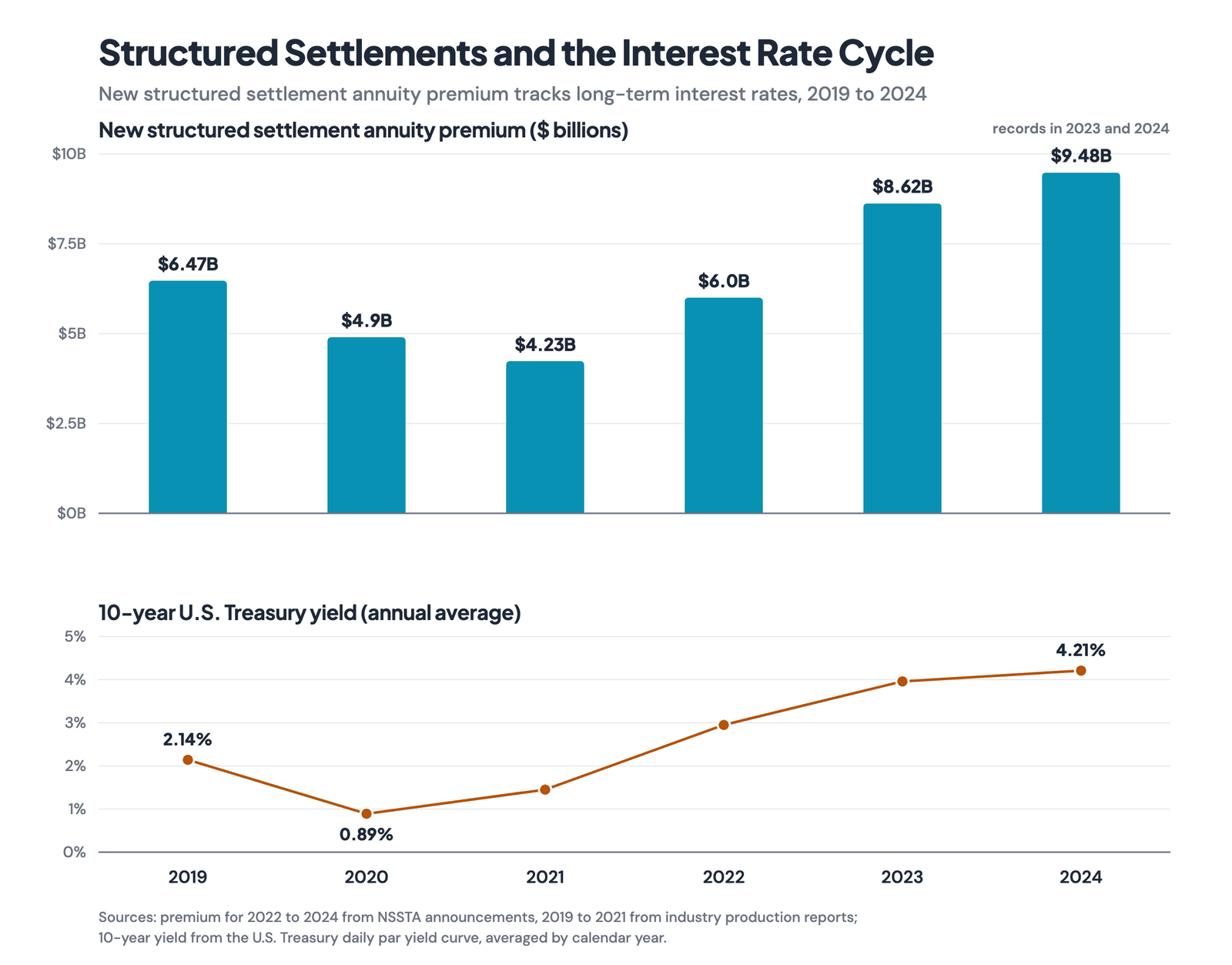
| Year | New SS premium | 10-year Treasury (annual avg.) | Note |
|---|---|---|---|
| 2019 | $6.47 billion | 2.14% | Record at the time, 26,486 cases |
| 2020 | $4.9 billion | 0.89% | Courts closed, yields collapsed |
| 2021 | $4.23 billion | 1.45% | The low point |
| 2022 | $6.0 billion | 2.95% | Recovery begins as rates rise |
| 2023 | $8.623 billion | 3.96% | All-time record |
| 2024 | $9.481 billion | 4.21% | Record again |
Premium figures for 2022 through 2024 come from NSSTA announcements (opens in a new tab). Figures for 2019 through 2021 come from annual production reports compiled and republished within the industry, and the two series are assembled by different publishers, so treat year-over-year comparisons across that seam with a little care. Treasury figures are calendar-year averages of the daily par yield curve (opens in a new tab). For the years before this window, the market ran near $5 billion to $6 billion annually for over a decade, with the pre-2019 high of $6.2 billion set back in 2008.
Why Higher Interest Rates Mean More Structured Settlements
Higher rates make the core trade better. A plaintiff structuring $500,000 of settlement money in 2024 received roughly a third more monthly income than the same premium bought in 2021, because the insurer could earn more on the bonds behind the promise. That changes real decisions at settlement tables.
Trial attorneys say so directly. Former American Association for Justice president David Casey, Jr. told Forbes (opens in a new tab) that higher rates "make structures more attractive," and New York trial lawyer Mitchel Ashley called a structured settlement in a high-rate market "a guaranteed cash flow with no thinking component to it." NSSTA's own 2026 industry outlook lists higher internal rates of return among the forces behind three straight record years.
Rates are not the whole story, and the industry itself says so. Volume stayed flat near $5 billion to $6 billion through the falling-rate 2010s, and one carrier analysis (opens in a new tab) found annual premium moved in the same direction as rates in exactly half of the years from 2008 to 2021. Better awareness among trial attorneys and the courts reopening after the pandemic also fed the recent records. What the 2020 to 2024 round trip shows more clearly than any earlier period is the rate effect at the extremes, with the market shrinking when yields hit generational lows and setting records once they normalized.
The carrier side tells the same story. Independent Life, the only insurer writing structured settlements exclusively, reported $50.5 million of annuity premium in 2020 and $228.9 million in 2024 in its statutory filings, growth that tracked the rate cycle even allowing for the company being young. Established issuers like the ones on our structured settlement annuity issuers page competed harder as volume returned, and new carriers entered the market.
What Structured Settlements Pay Now vs. the Low-Rate Years
The difference between eras is stark. In 2020 and 2021, typical structured settlement returns sat near 2 to 3 percent. By November 2022, industry brokers were publishing locked quotes at 5.7 percent tax free on a 10-year certain schedule, and intermediate and long schedules have generally quoted in the 4 to 5 percent range since. Because the return is tax free under Section 104(a)(2), a 5 percent structured rate outpays a taxable bond at 6.7 percent for someone in the 25 percent bracket.
Quotes are carrier-specific and move with the bond market, so treat any published number as a snapshot. The shape of your payment schedule matters as much as the headline rate. Deferred payments, lifetime payments with a certain period, and cost-of-living step-ups all price differently, which is why the same premium can produce very different-looking offers from different issuers.
What the Rate Cycle Means If You Already Receive Payments
If your structured settlement was set up in the low-rate years, your locked rate reflects that era. The payments are as safe as they ever were, but money is worth comparing. Some payees find their old structure no longer fits their situation, whether that means medical needs, a home purchase, or debt that costs more than the structure earns.
Rising rates cut both ways on the secondary market. Buyers of payment streams also price against today's yields, so discount rates on sales moved up alongside annuity rates. That makes it more important, not less, to compare offers carefully before selling. Our guides to selling a structured settlement and the tax rules on structured settlements cover the court approval process and what stays tax free after a transfer.
If you are weighing a sale of some or all of your payments, Catalina Structured Funding will give you a free, no-obligation quote and put it in writing. Our team includes licensed attorneys who handle the court process in every state where we operate. Call (800) 317-3769 or start with our structured settlement calculator.
Structured Settlement or Lump Sum in a High-Rate Market?
Higher rates strengthen the case for structuring at settlement, because the guaranteed income you give up a lump sum for is now meaningfully larger. The classic trade still applies. A lump sum offers flexibility and investment control, while a structure offers certainty, tax-free growth, and protection from spending down an award meant to last decades.
The right split is rarely all or nothing. Many settlements combine an up-front cash portion with structured payments timed to future needs. Our comparison of annuity payments versus a lump sum works through the decision factors, and the same logic applies at today's rates with the numbers shifted in the structure's favor.
Frequently Asked Questions
What is the interest rate on a structured settlement?
A structured settlement annuity does not have a posted interest rate. Each quote carries an internal rate of return set by the issuing life insurer, based on the bond yields available when the annuity is priced. In the 2020 to 2021 low-rate years, typical returns ran near 2 to 3 percent. With long-term Treasury yields above 4 percent, quoted returns have generally run in the 4 to 5 percent range or better, depending on the payment schedule and the carrier.
Are structured settlement earnings taxable?
No. Payments from a structured settlement funding a physical injury claim are excluded from income under Internal Revenue Code Section 104(a)(2), including the growth built into the payment stream. That tax treatment is what makes the effective yield on a structured settlement higher than a taxable bond paying the same stated rate.
Why did structured settlement sales set records in 2023, 2024, and 2025?
Higher interest rates made the payouts materially better. The same settlement dollars bought roughly a third more monthly income in 2024 than in 2021, so more plaintiffs and attorneys chose periodic payments. Industry premium rose from $4.23 billion in 2021 to a record $8.623 billion in 2023 and $9.481 billion in 2024, per NSSTA, and NSSTA reports the industry entered 2026 off another record year.
Do structured settlement rates change when the Federal Reserve moves rates?
Indirectly. Insurers price structured settlements off long-term bond yields, mainly corporate bonds and Treasuries with 10 to 30 year maturities, not the overnight rate the Fed sets. Long-term yields move on expectations, so structured settlement pricing can shift before or after a Fed decision, and carriers update their rate books on their own schedules.
How many structured settlements are set up each year?
Roughly 25,000 to 30,000 new structured settlement annuities are placed in a typical year in the United States. Industry production reports counted 26,486 cases funded with $6.47 billion of premium in 2019, an average of about $244,000 per case. Premium has grown sharply since then, topping $9 billion in 2024.
Can I sell my structured settlement payments if rates have gone up?
Yes. Every sale still requires court approval under your state's transfer act, and rising market rates affect pricing on the secondary market as well. If you are weighing a sale, get quotes in writing and compare the effective discount rate, not just the headline offer. Our guide to selling a structured settlement walks through the process step by step.
Key figures
Every figure below is explained and sourced in the article. Verified as of .
| Figure | Value | Source |
|---|---|---|
| New structured settlement premium, 2021 (the low) | $4.23 billion | Industry production reports |
| New structured settlement premium, 2023 (record) | $8.623 billion | NSSTA announcement, January 2024 |
| New structured settlement premium, 2024 (record) | $9.481 billion | NSSTA 40th anniversary release, July 2025 |
| Structured settlement cases funded in 2019 | 26,486 cases / $6.47 billion | Industry production reports |
| 10-year Treasury yield, 2020 vs 2025 (annual average) | 0.89% vs 4.29% | U.S. Treasury daily par yield curve, averaged by calendar year |
Cite this page
You are welcome to quote or cite this page. Copy a reference below, or read our citation guidelines for other formats and for how we source our data.
APA
Catalina Structured Funding. (2026). Structured Settlement Interest Rates: How the Rate Cycle Set Records. https://www.catalinastructuredfunding.com/blog/structured-settlement-interest-rates
Inline HTML attribution
According to <a href="https://www.catalinastructuredfunding.com/blog/structured-settlement-interest-rates">Catalina Structured Funding</a>, ...
Get a No Obligation Lump Sum Quote
Funds in as little as 24 hours
Get a No Obligation Lump Sum Quote
Funds in as little as 24 hours
Related Posts
Structured Settlement Examples: 5 Real-World Payment Designs Explained
The best way to understand structured settlements is to look at how real ones are built. A child's...
How to Find Your Structured Settlement: Lost Paperwork, Unknown Issuers, and Old Payments
Plenty of people receive settlement checks without knowing which company sends them, and plenty...
Why Are Structured Settlement Companies Calling Me?
If your phone keeps ringing with offers to buy your structured settlement, you are not alone and...