
At a glance · verified
- Statutory fee on the first $100,000
- 4%
- Statutory fee on the next $100,000
- 3%
- Statutory fee on the next $800,000
- 2%
- Statutory fee on the next $9 million
- 1%
- Statutory fee on the next $15 million
- 0.5%
California Probate Code § 10810 sets statutory probate fees on a graduated schedule, and § 10800 sets the executor's fee at the same rate. Here is the full breakdown with worked examples for $250K to $10M estates.
This content is for informational purposes only and does not constitute legal advice. Laws vary by state and are subject to change. Consult a qualified attorney for guidance on your specific legal situation.
California probate fees are set by statute, not by negotiation. Probate Code § 10810 fixes the attorney's fee on a graduated schedule of the estate's gross value, and § 10800 sets the executor's fee at the exact same rate. On a $500,000 estate, that is $13,000 to the attorney and $13,000 to the executor, for $26,000 in statutory fees before a single dollar reaches the heirs.
Below, we break down what California probate fees cover, the statutory schedule with worked examples, the court filing fees and out-of-pocket costs that come on top, when attorneys can bill above the schedule, who actually pays, and the legitimate ways to reduce what an estate spends on probate.
What California Probate Fees Cover
California probate fees fall into two groups: the statutory compensation paid to the attorney and the executor, and the out-of-pocket administration costs paid to the court and to third parties. Together they typically run 4 to 7 percent of a moderate estate's value.
The statutory compensation is the big one. It goes to two people. The attorney handling the probate receives a fee set by Probate Code § 10810, and the personal representative, the person the court appoints to run the estate, receives a separate fee set by § 10800 on the identical schedule. Both fees are paid from the estate.
The out-of-pocket costs are smaller individually but they add up. They include the court filing fees, the probate referee's appraisal fee, the cost of publishing legal notice in a newspaper, surety bond premiums when a bond is required, certified copies, and accounting or tax preparation if the estate needs it. We walk through each of these below.
The Statutory Fee Schedule Under Probate Code § 10810
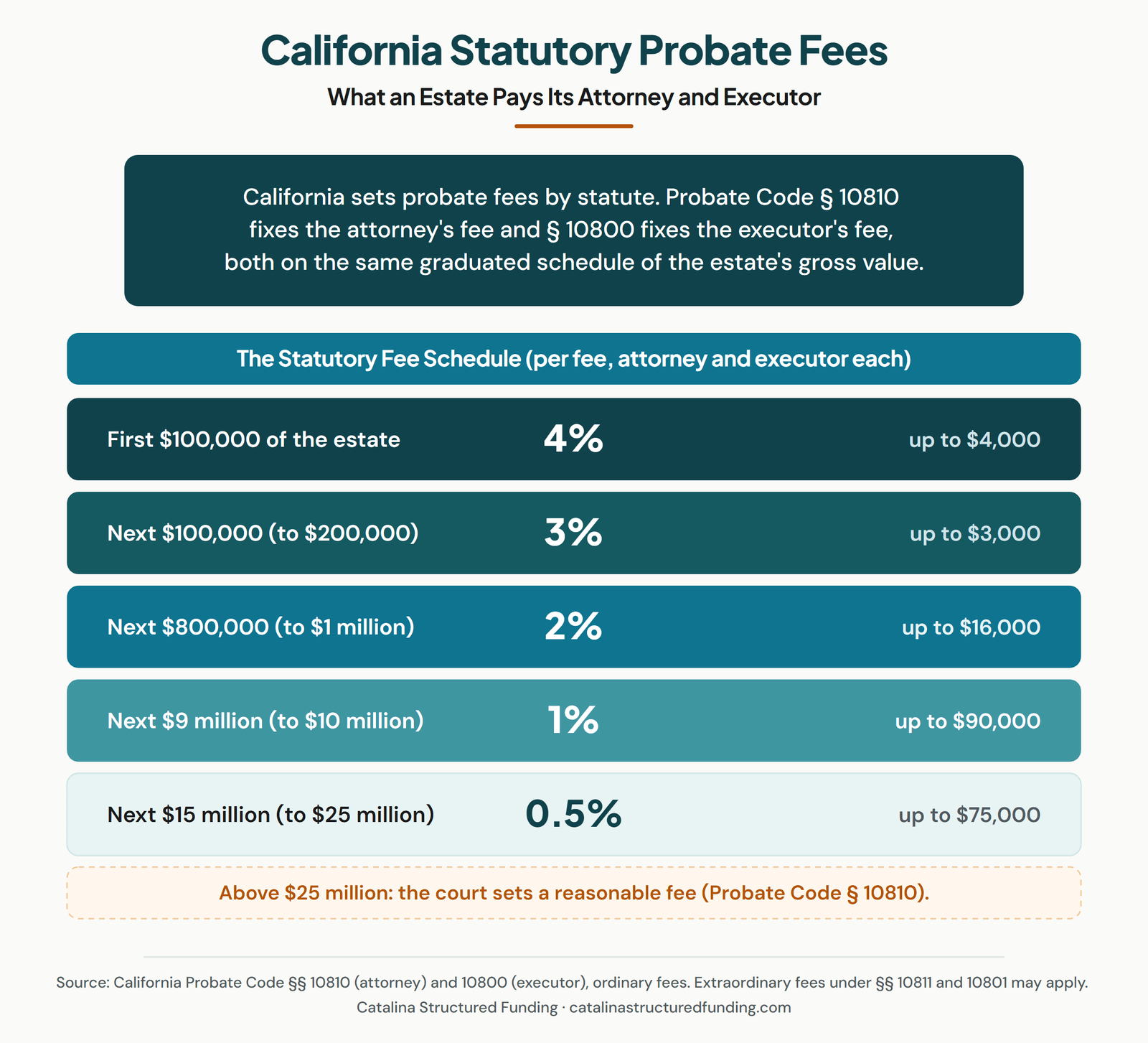
California Probate Code § 10810 sets attorney compensation for ordinary probate services on a graduated percentage of the estate's gross value. The schedule is 4 percent of the first $100,000, 3 percent of the next $100,000, 2 percent of the next $800,000, 1 percent of the next $9 million, and one-half of one percent of the next $15 million. For estates above $25 million, the court sets a reasonable fee.
The schedule is graduated, which means each rate applies only to the dollars inside its own bracket. The first $100,000 is always charged at 4 percent, the next $100,000 always at 3 percent, and so on up the ladder. No estate is charged a flat 4 percent or a flat 2 percent of the whole value.
The personal representative's fee under § 10800 uses the same brackets and the same percentages. So the statutory cost of probate is effectively double the § 10810 number, because the estate pays the attorney and the executor each at that schedule. The chart below visualizes that graduated bracket schedule.
How Statutory Fees Are Calculated: Worked Examples
To calculate a California statutory probate fee, you apply each bracket rate to the dollars that fall inside that bracket and add the results. The total is the attorney's fee, and the executor receives the same amount again.
Take a $250,000 estate. The first $100,000 at 4 percent is $4,000. The next $100,000 at 3 percent is $3,000. The remaining $50,000 at 2 percent is $1,000. Add those and the attorney's statutory fee is $8,000. The executor receives $8,000 as well, so the combined statutory fee on a $250,000 estate is $16,000.
The math scales up bracket by bracket. Here is what the combined attorney and executor fees come to across a range of estate sizes:
| Estate Value | Attorney Fee (§ 10810) | Executor Fee (§ 10800) | Combined Total |
|---|---|---|---|
| $250,000 | $8,000 | $8,000 | $16,000 |
| $500,000 | $13,000 | $13,000 | $26,000 |
| $1,000,000 | $23,000 | $23,000 | $46,000 |
| $3,000,000 | $43,000 | $43,000 | $86,000 |
| $10,000,000 | $113,000 | $113,000 | $226,000 |
Swipe to see all columns →
One detail drives larger fees than families expect. The fee is calculated on the gross value of the estate, without subtracting mortgages or other debts. A $900,000 house with a $600,000 mortgage is counted as $900,000 for the fee calculation, even though the equity is only $300,000. We see this surprise California heirs constantly, because a home that is mostly owed to the bank still generates a full statutory fee.
Here is how the pieces fit together in a typical case. Maria dies owning a California home appraised at $850,000, a $90,000 bank account, and a car and personal belongings worth $60,000. Her estate's gross value is $1,000,000. The statutory attorney fee is $23,000 and the executor fee is another $23,000, for $46,000 in statutory compensation. On top of that the estate pays roughly $435 to file the petition for probate, a similar amount again to file for final distribution, about $900 for the probate referee to appraise the non-cash assets, and a few hundred dollars to publish legal notice. All in, the estate spends close to $48,000 on probate before Maria's heirs receive anything. And the home counts at its full $850,000 even if Maria still owed money on the mortgage.
Why California Probate Fees Run Higher Than in Most Other States
California probate fees run higher than the national norm because of how the state structures them. California is one of only a few states that fixes probate compensation by a mandatory percentage-of-value statute. Most states pay the attorney and the personal representative a reasonable fee that the court reviews, and that reasonable fee frequently lands well below what California's schedule produces.
Two features of the California system compound the cost. The first is that the § 10810 schedule is calculated on gross value, with no credit for mortgages or other debt against the estate's property. The second is California real estate. Home values in California are among the highest in the country, so an ordinary house can single-handedly carry an estate past the $1 million mark and into the higher fee brackets. A family in a state with a reasonable-fee system and lower home values often pays a fraction of what the same estate costs in California.
This is the reason California estate planners push revocable living trusts so hard. A trust does not change the size of the estate, but it keeps assets out of the probate court, and the § 10810 schedule only reaches assets that go through probate. For a California family whose main asset is a home, deciding whether to set up a trust is often a five-figure decision.
Court Filing Fees: What You Pay to Open Probate
The court filing fee to open a California probate case is a few hundred dollars, paid when the petition for probate is filed. The statewide first-paper filing fee is currently $435, and some counties add a modest local surcharge on top.
That first fee is not the only one. A second filing fee of the same amount is generally due when the personal representative files the petition for final distribution to close the estate. Counties may also charge for certified copies of the Letters that authorize the personal representative to act, and those copies are needed to deal with banks and title companies. Our guide to California probate forms covers which Judicial Council form each of these filings uses.
Filing fees are modest next to the statutory compensation, but they are real cash that someone has to advance early in the case, often before any estate money is available. The California Courts self-help center (opens in a new tab) publishes current fee information by county.
Bond Premiums, Publication Costs, and Other Out-of-Pocket Expenses
Beyond filing fees, a California probate carries several third-party costs. The most common are the probate referee's fee, newspaper publication, and, when required, a surety bond premium.
The probate referee is a court-appointed appraiser who values the estate's non-cash assets, such as real estate, business interests, and collectibles. Under Probate Code § 8961, the referee is paid one-tenth of one percent of the value of the assets appraised. On a $900,000 house, that is $900.
Publication is required to give notice that the estate is being administered. The personal representative must publish the notice of petition in a newspaper of general circulation, and the cost varies widely by county and newspaper, often from $200 to over $1,000.
A surety bond protects the estate against mismanagement by the personal representative. A bond is not always required, because a will can waive it and the heirs can sometimes waive it, but when it is required the annual premium runs roughly one-half of one percent of the bond amount. Accounting and tax preparation fees apply when the estate is complex enough to need a CPA.
These fees apply to a lot of estates. California courts handle more than 41,000 estate and trust probate filings a year, and our California probate statistics breakdown shows how that volume splits across all 58 counties.
Probate fees come out of the estate before heirs are paid, and a California estate can take well over a year to close. If you are an heir who needs cash now, Catalina Structured Funding can advance a portion of your inheritance, with approval based on the estate rather than your credit. Call (800) 317-3769 for a free quote, or read more about California probate advances.
Extraordinary Fees: When Attorneys Can Bill Above the Statutory Schedule
Extraordinary fees are amounts the court awards on top of the statutory schedule when the attorney or the personal representative performs services beyond ordinary administration. They are governed by Probate Code § 10811 for the attorney and § 10801 for the personal representative.
Ordinary services are the routine work of any probate: filing the petition, marshaling assets, paying valid creditor claims, preparing the inventory, and distributing the estate. Extraordinary services are the unusual work that some estates require. Common examples include selling real property, defending or prosecuting a will contest, operating the decedent's business during administration, handling complex tax matters, and litigating disputes among heirs.
Extraordinary fees are not automatic and they are not on a percentage schedule. The attorney or executor petitions the court, documents the extra work, and the judge decides what is reasonable. An estate with a contested will or a difficult real estate sale can see extraordinary fees add thousands of dollars to the cost of probate.
A concrete example shows how this works. Say the estate's main asset is a house that has to be sold during administration. The attorney's work in handling that sale, the listing, reviewing offers, and a court confirmation hearing in a supervised sale, can support an extraordinary fee award. So can defending the estate against a creditor lawsuit or untangling several years of unfiled income tax returns. The court weighs the time spent, the difficulty, and the result, then awards what it finds reasonable. There is no cap, but there is no entitlement either. Every dollar of extraordinary compensation has to be asked for, documented, and justified to the judge.
Who Actually Pays the Fees: The Estate, Not the Heirs
California probate fees are paid by the estate, not by the heirs personally. No heir ever has to write a check for the attorney's fee or the executor's fee out of their own funds. The fees are paid from estate assets before the estate is distributed.
That said, the fees still come out of the heirs' pockets in a real sense, just indirectly. Every dollar the estate spends on probate is a dollar that does not get distributed. On a $500,000 estate, the roughly $26,000 in combined statutory fees, plus filing fees, publication, and the referee, means the heirs collectively receive perhaps $30,000 to $40,000 less than the headline value of the estate.
For a sole heir, that is a direct reduction in the inheritance. For an estate with several heirs, the fees come off the top before the remainder is divided. Either way, understanding the fee structure tells you what to actually expect when the estate closes.
How Probate Fees Get Paid Before Distribution
Probate fees are paid near the end of the case, when the personal representative asks the court to approve the final accounting and order distribution. The fees are not paid as the work happens. They are paid once, at the close.
California law sets an order of priority for what the estate pays. Probate Code § 11420 ranks the claims, and the costs and expenses of administration, which include the statutory fees, sit at the top of that order, ahead of general creditors. The personal representative cannot distribute anything to the heirs until administration expenses and valid debts are satisfied.
In practice, the sequence is: the estate's assets are collected and, if needed, sold, valid creditor claims and taxes are paid, the attorney and executor fees are approved and paid, and only then is the remaining balance distributed to the heirs. This is the structural reason a probate advance exists. The heirs' money is real, but it is locked behind months of administration. We go deeper into that timeline in our California probate timeline guide. And if you are the one waiting on the other end of this sequence, our guide to how long an executor has to pay beneficiaries covers the same process from the heir's side, including your rights when it stalls.
California does allow one form of early access through the court itself. Under the preliminary distribution rules in Probate Code §§ 11620 through 11624, a personal representative or an heir can petition the court to release part of an heir's share before the estate formally closes, as long as enough value remains to cover debts, taxes, and the administration fees. Judges grant these petitions when the estate is clearly solvent. In practice, though, many personal representatives are cautious about asking, because they remain personally responsible if the estate later turns out to be short. A preliminary distribution also still runs on the court's calendar, which means a hearing and a wait. That combination is one reason heirs look outside the estate for a faster option.
How to Reduce California Probate Fees (Legitimately)
The most reliable way to reduce California probate fees is to keep assets out of probate in the first place, because the statutory schedule only applies to assets that pass through a probate case. Several tools do this.
- A revocable living trust. Assets held in a properly funded living trust pass to beneficiaries without probate, so they generate no statutory § 10810 or § 10800 fee at all. This is the single biggest fee saver for a California estate of any size.
- Beneficiary designations and pay-on-death accounts. Life insurance, retirement accounts, and pay-on-death or transfer-on-death bank and investment accounts pass directly to the named beneficiary and never enter probate.
- Joint tenancy with right of survivorship. Property held this way passes automatically to the surviving owner outside probate.
- Small estate procedures. California offers simplified alternatives when the estate is below certain thresholds. The small estate affidavit under Probate Code § 13100 covers personal property up to $208,850, and a separate petition can transfer a decedent's primary residence valued up to $750,000 without full probate. Our guide to transferring property after a death in California walks through all three simplified paths, and the small estate affidavit process covers that route in depth.
There is also one reduction that happens inside an active probate. When a family member serves as the personal representative, that person can waive the § 10800 executor fee. The executor fee is taxable income to whoever receives it, while an inheritance generally is not taxed as income, so a family-member executor who is also an heir frequently declines the fee and simply takes their inheritance instead. When the executor waives the fee, the estate pays only the attorney's § 10810 fee, which cuts the statutory cost of probate roughly in half.
One thing does not reduce the fee: paying down a mortgage. Because the statutory fee is calculated on gross value, debt against an asset does not lower the fee. The only way to avoid the fee on an asset is to keep that asset out of the probate estate entirely. If you want to estimate the numbers for a specific estate, our probate advance calculator applies the California statutory schedule directly.
Frequently Asked Questions
How much are California probate attorney fees?
California probate attorney fees are set by statute, not negotiated. Probate Code § 10810 fixes them on a graduated schedule: 4 percent of the first $100,000 of the estate, 3 percent of the next $100,000, 2 percent of the next $800,000, 1 percent of the next $9 million, and one-half of one percent of the next $15 million. A $500,000 estate produces a $13,000 attorney fee.
Who pays the statutory probate fees in California?
The estate pays. Statutory attorney and executor fees, court filing fees, the probate referee fee, and publication costs all come out of the estate before anything is distributed to the heirs. Heirs never pay probate fees out of their own pockets, but the fees do reduce the size of every inheritance that comes out of the estate.
Can California probate fees be negotiated?
The statutory fee for ordinary services cannot be negotiated up or down. Probate Code § 10812 makes an agreement for higher attorney compensation void. Extraordinary fees under §§ 10811 and 10801 are different, because the court sets those based on the actual extra work performed, so they are reviewed case by case.
What are extraordinary probate fees in California?
Extraordinary fees are amounts the court awards on top of the statutory schedule for services beyond ordinary administration, such as selling real property, handling a will contest, operating a business, or resolving tax disputes. They are governed by Probate Code § 10811 for the attorney and § 10801 for the executor, and the court must approve them.
How are California probate fees calculated when the estate has both real and personal property?
The statutory fee is calculated on the gross value of the entire estate, real and personal property combined, without subtracting mortgages or other debts. A $900,000 house with a $600,000 mortgage still counts as $900,000 for the fee calculation. The probate referee appraises the non-cash assets to establish that gross value.
If you are an heir to a California estate and the probate fees and timeline mean you are waiting months for your inheritance, Catalina Structured Funding can give you a free probate advance quote within 24 hours. Approval is based on the estate, not your credit, and the amount we quote is the amount you receive. Call (800) 317-3769 or request a quote on this page.
Key figures
Every figure below is explained and sourced in the article. Verified as of .
| Figure | Value | Applies to | Source |
|---|---|---|---|
| Statutory fee on the first $100,000 | 4% | Attorney and executor, each | Cal. Prob. Code §§ 10810, 10800 |
| Statutory fee on the next $100,000 | 3% | Attorney and executor, each | Cal. Prob. Code §§ 10810, 10800 |
| Statutory fee on the next $800,000 | 2% | Attorney and executor, each | Cal. Prob. Code §§ 10810, 10800 |
| Statutory fee on the next $9 million | 1% | Attorney and executor, each | Cal. Prob. Code §§ 10810, 10800 |
| Statutory fee on the next $15 million | 0.5% | Attorney and executor, each | Cal. Prob. Code §§ 10810, 10800 |
| Estates above $25 million | Set by court | Reasonable fee, judicial discretion | Cal. Prob. Code §§ 10810, 10800 |
Sources
7 cited sources. Every authority below appears in the article above and was reviewed by our editorial team. See our editorial standards for our sourcing policy.
- StatuteCal. Probate Code § 10810 (Statutory schedule for attorney compensation for ordinary services) (opens in a new tab)
- StatuteCal. Probate Code § 10800 (Compensation of the personal representative, same statutory schedule)
- StatuteCal. Probate Code § 10811 (Extraordinary attorney compensation, set by the court)
- StatuteCal. Probate Code § 10801 (Extraordinary compensation of the personal representative)
- StatuteCal. Probate Code § 8961 (Probate referee compensation, one-tenth of one percent of appraised assets)
- StatuteCal. Probate Code § 11420 (Order of payment of debts and administration expenses before distribution)
- StatuteCal. Probate Code §§ 11620-11624 (Preliminary distribution to heirs before the estate closes)
Cite this page
You are welcome to quote or cite this page. Copy a reference below, or read our citation guidelines for other formats and for how we source our data.
APA
Catalina Structured Funding. (2026). California Probate Fees: What an Estate Actually Pays. https://www.catalinastructuredfunding.com/blog/california-probate-fees
Inline HTML attribution
According to <a href="https://www.catalinastructuredfunding.com/blog/california-probate-fees">Catalina Structured Funding</a>, ...
Get a No Obligation Lump Sum Quote
Funds in as little as 24 hours
Get a No Obligation Lump Sum Quote
Funds in as little as 24 hours
Related Posts
You Received a Notice of Petition to Administer Estate (DE-121): What It Means and What Happens Next
A California court notice arrived because someone asked the court to open probate and listed you as...
Can the Executor Give Me an Advance on My Inheritance?
An executor can release part of your inheritance before probate closes, but only as a partial...
How to Pay for the Funeral and Bills Before Probate Closes
The estate owes the funeral bill and the deceased's debts, but it cannot write a check until the...