
Texas Estates Code §§ 201.001-201.103 sets who inherits when someone dies without a will. The rules turn on community property, separate property, and the Texas homestead. Full framework with a chart.
This content is for informational purposes only and does not constitute legal advice. Laws vary by state and are subject to change. Consult a qualified attorney for guidance on your specific legal situation.
If a Texas resident dies without a will, the Texas Estates Code decides who inherits. The surviving spouse and the decedent's children come first, but how much each receives depends on something most families do not expect. The answer turns on whether the property is community property or separate property, and on whether every child is also the surviving spouse's child. Texas Estates Code §§ 201.001 through 201.103 set the framework.
Below, we explain what intestate means in Texas, how community and separate property are divided, the surviving spouse's share, the shares for children and other relatives, the special rules that protect the Texas homestead, the determination of heirship process, and the situations that change the outcome, including half-blood relatives, adopted children, and informal marriage.
What "Intestate" Means in Texas
Intestate means a person died without a valid will, or with a will that does not effectively dispose of all of their property. When that happens, the Texas Estates Code supplies a default plan of distribution, and the people who inherit under that plan are called heirs.
The framework applies in three situations. The first is the obvious one, where the decedent never signed a will or the will was found invalid. The second is partial intestacy, where a valid will exists but does not cover every asset, often because the decedent bought property after signing the will and never updated it. The covered assets pass under the will, and the uncovered assets pass by intestate succession. The third is a failed gift, where a named beneficiary died before the decedent and the will has no backup beneficiary.
Whichever situation applies, the analysis starts the same way. First identify what kind of property the decedent owned, then walk through the priority order in Texas Estates Code §§ 201.001 through 201.003. If you are reading this because a parent or spouse recently passed away without a will, that two-step analysis is what the probate court will run, and it is what we walk through next.
How Texas Distributes an Intestate Estate
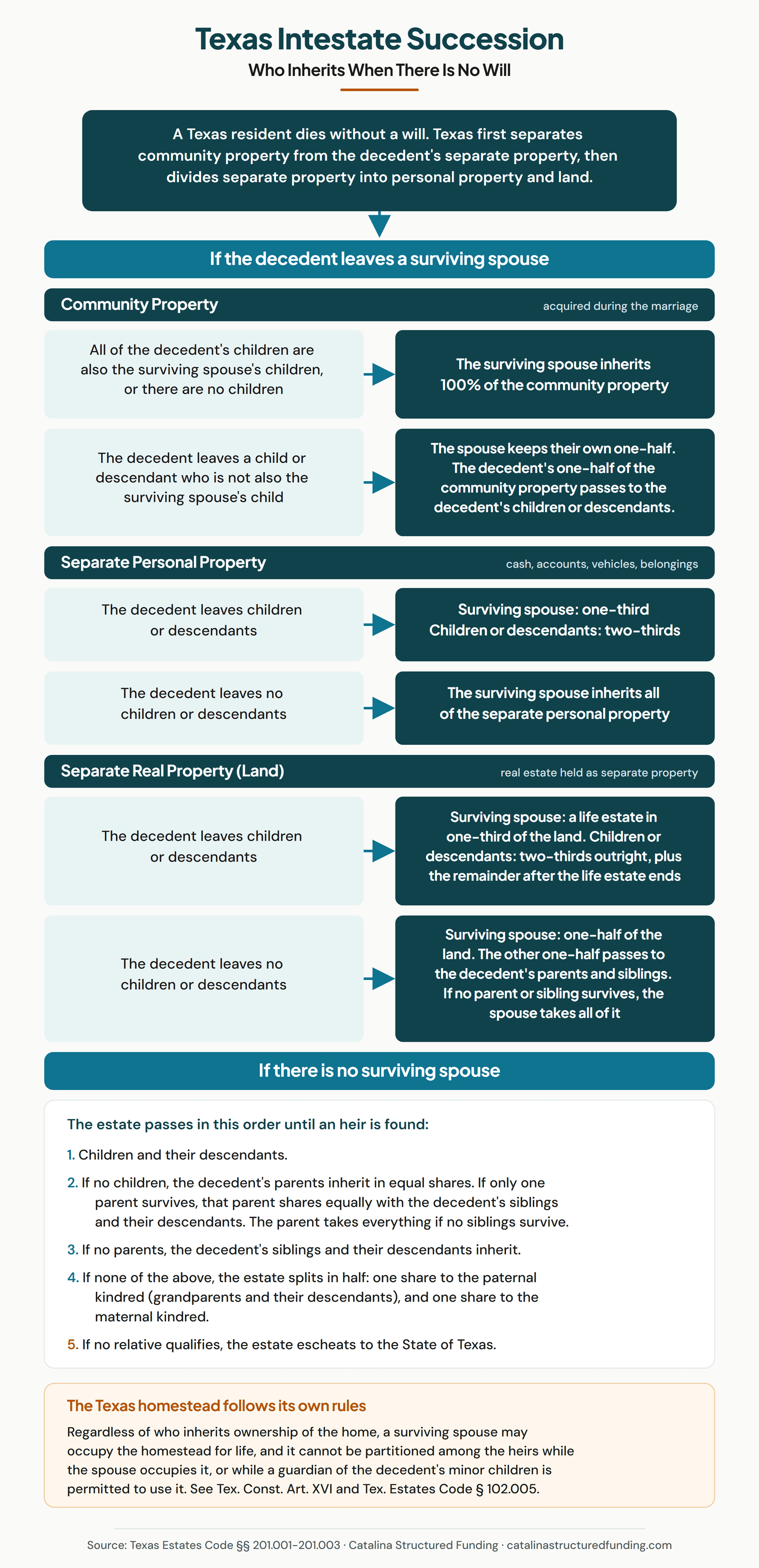
A Texas intestate estate is divided first into community property and separate property, and the separate property is divided again into personal property and real property. Each category follows its own descent rule under Texas Estates Code §§ 201.001 through 201.003.
That sounds more complicated than it is in practice. Here is the short version. If there is a surviving spouse, the community property and the separate property each pass under their own rules, and the surviving spouse almost always receives a meaningful share. If there is no surviving spouse, the entire estate passes down a single priority ladder, starting with the decedent's children.
The priority ladder, in plain language, runs in this order:
- Surviving spouse. Takes a share of community property and separate property that depends on the property type and on who else survives.
- Children of the decedent and the descendants of any child who died first.
- Parents of the decedent, if no spouse or children survive.
- Siblings of the decedent and their descendants, if no parents survive.
- Grandparents and more distant relatives, split between the paternal and maternal sides.
- The State of Texas, by escheat, only if no relative qualifies.
The chart above shows how each branch resolves. The rest of this guide explains each branch in detail, starting with the distinction that drives everything else in Texas: community property versus separate property.
Community Property vs. Separate Property in Texas
Texas is a community property state, and the distinction between community and separate property is the single most important factor in a Texas intestate estate. Community property is property acquired by either spouse during the marriage. Separate property is property a spouse owned before marriage, or acquired during marriage by gift or inheritance.
Texas adds one category most other states do not. A recovery for personal injuries sustained by a spouse during marriage is generally that spouse's separate property, except for the part that compensates for lost earning capacity. That detail matters when the estate includes a structured settlement or a personal injury award.
The reason the classification matters so much is that community property and separate property descend under completely different rules at intestacy. We see Texas families misled by general probate guides written for non-community-property states, because those guides do not account for this split at all. Before anyone can answer who inherits, the estate's property has to be sorted into community property, separate personal property, and separate real property.
Sorting property into the right category is not always straightforward. Texas law presumes that property a couple holds at death is community property, and the spouse or heir who claims an asset is separate property carries the burden of proving it by clear and convincing evidence under Texas Family Code § 3.003. Proving separate property usually means tracing the asset back to a pre-marriage purchase, a gift, or an inheritance, with deeds, account statements, or estate records. When separate funds and community funds have sat mixed in the same account for years, that tracing becomes difficult, and disputes over classification are one of the most common sources of conflict in a Texas intestate estate. Our companion guide on intestate succession in California covers the same community-property split for California families, and the two states reach the result differently.
The Surviving Spouse's Share Under § 201.003
A surviving spouse's intestate share in Texas depends on the type of property and on whether every one of the decedent's children is also a child of the surviving spouse. The community property rule is in Texas Estates Code § 201.003, and the separate property rule is in § 201.002.
Start with community property. Under § 201.003, the deceased spouse's one-half of the community estate passes entirely to the surviving spouse in two situations. The first is when no child or descendant of the deceased spouse survives. The second is when all of the surviving children and descendants of the deceased spouse are also children or descendants of the surviving spouse. In other words, in a marriage where every child belongs to both spouses, the surviving spouse keeps all of the community property.
The result changes when the decedent leaves a child from another relationship. If the deceased spouse is survived by a child or descendant who is not also a child of the surviving spouse, the deceased spouse's one-half interest in the community estate passes to the deceased spouse's children or descendants. The surviving spouse still keeps their own one-half of the community estate, but they do not inherit the decedent's half. This is the rule that surprises blended families most often.
Separate property follows § 201.002, and it splits separate personal property from separate real property:
- Separate personal property, with children. The surviving spouse takes one-third, and the decedent's children and their descendants take the remaining two-thirds.
- Separate personal property, no children. The surviving spouse takes all of it.
- Separate real property, with children. The surviving spouse takes a life estate in one-third of the land, and the children and their descendants take the other two-thirds outright plus the remainder interest in the spouse's one-third. A life estate means the spouse may use the land for life, after which full ownership passes to the children.
- Separate real property, no children. The surviving spouse takes one-half of the land outright. The other one-half passes to the decedent's parents, siblings, and their descendants. If the decedent leaves no surviving parent, sibling, or sibling's descendant, the surviving spouse takes the entire estate.
A worked example shows how the categories stack. Say a married Texan dies without a will, leaving a surviving spouse and two children who belong to both spouses. The couple's home and bank accounts are community property, so the spouse keeps all of it. The decedent also owned a rent house bought before the marriage, which is separate real property. The spouse receives a life estate in one-third of that rent house, and the two children divide the rest. The spouse may live in or rent out their one-third share for life, and the children own everything else.
Waiting on a Texas intestate estate and need cash before it closes? Catalina Structured Funding can advance a portion of your inheritance, often within 24 to 48 hours, with approval based on the estate rather than your credit. Call (800) 317-3769 for a free quote, or read more about Texas probate advances.
Children, Parents, and Other Heirs Under § 201.001
When a Texas resident dies intestate with no surviving spouse, the entire estate passes to the decedent's relatives in the order set by Texas Estates Code § 201.001. Each tier inherits only if no one in a higher tier survives.
The order works like this. The estate passes first to the decedent's children and the descendants of any child who died before the decedent. If no child or child's descendant survives, the estate passes in equal portions to the decedent's father and mother.
The rule for parents has a wrinkle that catches people off guard. If only one parent survives, the estate divides into two equal portions. One portion goes to the surviving parent, and the other goes to the decedent's siblings and their descendants. If only one parent survives and there are no siblings or their descendants, the entire estate goes to that surviving parent. If neither parent survives, the entire estate passes to the decedent's siblings and their descendants.
When none of those relatives survive, § 201.001 divides the estate into two moieties, which simply means two equal halves. One half passes to the paternal side of the family, starting with the paternal grandparents and moving to their descendants, and the other half passes to the maternal side in the same way. Only when no relative on either side qualifies does the estate escheat to the State of Texas. Escheat is rare, because the statute reaches a wide circle of kin before it ever gets there.
Here is how the parent rule plays out. Say an unmarried Texan dies without a will and without children, survived by their mother and two siblings, with the father already deceased. Because only one parent survives, the estate divides into two equal halves. The mother takes one half, and the two siblings split the other half between them. If both parents had survived, they would have shared the entire estate equally, and the siblings would have taken nothing. The presence of one living parent rather than two is what opens the door for the siblings.
The Texas Homestead: A Special Set of Rules
The Texas homestead does not follow the ordinary intestate rules. Ownership of the homestead descends to the heirs like other real property, but a surviving spouse and the decedent's minor children have a separate, constitutionally protected right to occupy the home.
This protection comes from Article XVI of the Texas Constitution (opens in a new tab) and from Texas Estates Code § 102.005. The practical effect is that even if the children inherit ownership of the family home, the surviving spouse may continue to live there for life. Under § 102.005, the homestead cannot be partitioned among the heirs while the surviving spouse occupies it as a homestead, or while a guardian of the decedent's minor children is permitted to use it under a court order.
That means an heir who inherits a fractional ownership interest in the homestead generally cannot force a sale while the surviving spouse still lives there. For a child who inherits a share of the family home alongside a surviving stepparent, the practical reality is that the inheritance is real but not liquid. The ownership interest exists on paper, but the cash value of it is locked up until the surviving spouse moves out, passes away, or chooses to sell. This is one of the most common reasons Texas heirs look into a probate advance, because the advance lets them access the value of an interest they cannot yet sell.
The homestead carries one more protection that matters to heirs. Under Texas Estates Code § 102.004, when the decedent is survived by a spouse or a minor child, the homestead passes to the heirs free of the debts of the estate, with narrow exceptions for items like purchase-money liens, property taxes, and home improvement loans. A general creditor of the estate cannot force the sale of the inherited homestead to satisfy an ordinary debt. For an heir, that makes the family home one of the most protected assets in the entire estate.
Determination of Heirship: How Texas Identifies the Heirs
When a Texan dies without a will, the probate court usually has to run a formal proceeding called a determination of heirship to officially identify who the heirs are. It is governed by Texas Estates Code §§ 202.001 through 202.207, and it is more involved than the typical will-based probate.
In a determination of heirship, an applicant asks the court to declare who the decedent's heirs are and what share each one takes. The court appoints an attorney ad litem to represent the interests of any heirs who are unknown, missing, or legally incapacitated. The case also requires testimony from two disinterested witnesses, meaning people who knew the family but have nothing to gain from the estate, who can describe the decedent's marital history and children.
This proceeding exists to protect everyone with a potential claim, and that protection takes time. The court will not order distribution until the heirs are legally established. For an heir who needs money before the case finishes, the determination of heirship stage is often the longest wait, which is why many Texas heirs ask about a probate advance while it is still pending.
Texas also recognizes a lighter alternative for some estates. An affidavit of heirship is a sworn statement of the decedent's family history, usually signed by two disinterested witnesses and recorded in the real property records of the county where the decedent's land sits. It is most often used to clear title to real estate when a full administration is not otherwise needed. Under Texas Estates Code § 203.001, a recorded affidavit of heirship becomes prima facie evidence of the facts it states once it has been on record for five years. It does not replace a court order in every situation, but for a straightforward estate whose main asset is a home, it can be the faster path.
Half-Blood Relatives, Adopted Children, and Other Special Situations
Several Texas-specific rules change who counts as an heir and how much they take. These come up constantly in real estates, and most of them are not intuitive.
Half-Blood Relatives
Texas treats half-blood relatives differently from full-blood relatives. Under Texas Estates Code § 201.057, when collateral kindred of both whole and half blood inherit, each half-blood relative inherits only half as much as each whole-blood relative. Collateral kindred means relatives who are not direct ancestors or descendants, such as siblings. If every collateral relative who inherits is of half blood, then each one inherits a whole, equal portion. This half-share rule is different from California, where half-blood relatives inherit the same share as full-blood relatives.
Adopted Children
An adopted child inherits in Texas under Texas Estates Code § 201.054. The adopted child inherits from and through the adoptive parents and their relatives exactly as a biological child would, and the adoptive parents inherit from the adopted child. Texas also keeps a link to the biological family that many states cut. The adopted child may still inherit from and through their biological parents, although the biological parents and their relatives may not inherit from or through the adopted child. One exception applies to adult adoptions under Family Code § 162.507, which can end the inheritance link to the biological family.
Children Born Outside Marriage
A child whose parents were not married still inherits from the mother automatically, and inherits from the biological father once paternity is established under Texas Estates Code § 201.052. Paternity can be established by the circumstances of the child's birth under the Family Code, by a court decree, by the father's adoption of the child, or by a valid acknowledgment of paternity. If none of those apply, the child may petition the probate court, which can recognize the parent-child relationship on clear and convincing evidence of biological paternity.
Posthumously Conceived and In-Gestation Children
A child who was conceived before the decedent's death but born afterward can still inherit. Under Texas Estates Code § 201.056, a person is considered to be in gestation at the time of death if implantation occurred at or before that time, and a child born within 300 days after the death is presumed to have been in gestation. The child must survive at least 120 hours to take an intestate share.
Informal (Common-Law) Marriage in Texas
Texas is one of the few states that still recognizes informal marriage, often called common-law marriage. Under Texas Family Code § 2.401, an informal marriage can be proved either by a signed declaration of marriage, or by showing that the couple agreed to be married, then lived together in Texas as spouses and represented to others that they were married. An informal spouse inherits exactly like a ceremonially married spouse. The catch is proof. If no proceeding to prove the marriage begins within two years after the couple separated, the law presumes there was no agreement to be married. A surviving informal spouse should act quickly to establish the marriage before the estate is distributed.
Stepchildren and Foster Children
Stepchildren and foster children do not inherit through Texas intestate succession unless they were legally adopted. A long relationship and shared household are not enough on their own. A narrow doctrine called adoption by estoppel can sometimes allow a child to inherit from a person who agreed to adopt them but never completed the paperwork, but it is fact-specific and contested, and it should not be assumed.
Why Intestate Probate in Texas Takes Longer
Texas intestate probate typically runs 9 to 18 months, longer than a straightforward probate with a will. The determination of heirship proceeding is the main reason. It adds the attorney ad litem appointment, the two-witness testimony requirement, and additional notices to potential heirs, all of which take calendar time.
Other factors stretch the timeline further. Estates with real property in more than one county, blended-family disputes over who is an heir, and missing or hard-to-locate relatives all add months. We have seen Texas heirship cases that everyone expected to close in under a year run well past two years once a contested claim appeared. Our broader guide on how long probate takes covers the state-by-state picture in more detail.
Texas does have one feature that speeds things up. Independent administration, governed by Texas Estates Code §§ 401.001 through 402.054, lets the personal representative settle the estate with minimal court supervision. Even an intestate estate can qualify for independent administration if all of the distributees agree to it. When the heirs cooperate, this can shave significant time off the process.
What Heirs Should Do During an Intestate Probate
If you are an heir to a Texas intestate estate, a few practical steps protect your interest while the case moves forward. First, make sure the estate is actually opened in the right county and that a determination of heirship has been requested. Nothing distributes until the heirs are legally established.
Second, keep in contact with the personal representative or the estate's attorney. Many delays in Texas heirship cases come from heirs who cannot be reached, paperwork that goes unsigned, or family-history questions that no one answers. The estate cannot close around you if it cannot find you.
Third, if you need money before the estate distributes, look into a probate advance. A surviving spouse may also be entitled to a family allowance under Texas Estates Code §§ 353.101 through 353.108, which provides for the maintenance of the surviving spouse and minor children for one year, paid from the estate before general distribution. A family allowance and a probate advance serve different needs, and an heir can sometimes use both. We explain the advance option in the next section.
When Intestate Succession Does Not Apply
Intestate succession only controls the decedent's probate estate. Many assets pass outside of probate entirely, and those assets are not affected by the rules in this guide, even when there is no will.
The most common non-probate assets are life insurance policies and retirement accounts with a named beneficiary, payable-on-death and transfer-on-death bank and investment accounts, real estate held with a transfer-on-death deed, property owned in joint tenancy with a right of survivorship, and assets titled in a living trust. Each of these passes directly to the named beneficiary or surviving owner by its own terms.
This is why two heirs of the same estate can end up with very different outcomes. One heir named as a payable-on-death beneficiary on a large account may receive that money within weeks, while another heir waiting on the probate estate may wait a year or more. If you are unsure which category an asset falls into, the estate's attorney can tell you, and it is worth asking early.
Why CSF for Texas Intestate Probate Advances
An intestate estate can take well over a year to distribute, and Texas heirs often need money long before then. A probate advance from Catalina Structured Funding gives you access to part of your expected inheritance now, without waiting for the determination of heirship and final distribution to finish.
A probate advance is not a loan. It is a purchase. CSF buys a portion of your expected inheritance, and we are repaid directly from the estate when it distributes. There are no monthly payments, no credit check, and no personal liability. If the estate ultimately distributes less than expected, CSF absorbs that shortfall, not you. That non-recourse protection is the core difference between an advance and a loan, and it matters most in intestate cases, where the final number can shift as the heirship is sorted out.
We have funded thousands of probate and inheritance transactions, and we work with Texas estates regularly, including estates still in the determination of heirship stage. The amount we quote is the amount you receive. Before you decide, get quotes from more than one company and compare the net amount each one offers. You can also compare providers on our probate advance companies page, estimate a range with our probate advance calculator, and read about our editorial standards and the attorney-led team behind the legal information on this site.
The fastest way to find out what your Texas inheritance is worth as a lump sum is to call us at (800) 317-3769 or request a quote on this page. There is no cost, no obligation, and no pressure. For background on how estates are taxed before you receive your share, see our inheritance tax guide, and for the general picture of dying without a will, see our overview on what happens when someone dies without a will.
Frequently Asked Questions
Who inherits when there is no will in Texas?
Texas Estates Code §§ 201.001 through 201.003 sets the order. A surviving spouse takes all of the community property when every child is also the spouse's child, plus a share of the separate property. Children come next, then parents and siblings, then more distant relatives. If no relative qualifies, the estate escheats to the State of Texas.
How much does a surviving spouse inherit if there is no will in Texas?
It depends on the property type. The surviving spouse takes all of the community property if every child is also the spouse's child. For separate personal property the spouse takes one-third when children survive and all of it when none do. For separate real property the spouse takes a one-third life estate when children survive, and one-half outright when none do.
How does the Texas homestead pass when someone dies without a will?
The homestead descends to the heirs like other real property, but a surviving spouse may occupy it for life regardless of who inherits ownership. Under Texas Estates Code § 102.005, the homestead cannot be partitioned among the heirs while the surviving spouse occupies it or while a guardian of the decedent's minor children is permitted to use it.
How much can I get from a probate advance on a Texas intestate estate?
Most CSF probate advances fund 30 to 50 percent of the heir's expected share. On a $150,000 expected distribution, that is roughly $45,000 to $75,000, depending on the discount rate and the projected timeline to final distribution. The amount we quote is the amount you receive, and the remaining balance comes to you when the estate distributes.
How long does intestate probate take in Texas?
Texas intestate probate usually takes 9 to 18 months, longer than a simple will-based probate. The determination of heirship proceeding, the appointment of an attorney ad litem, and the additional notice requirements all add time. Contested heirship can stretch the case past two years.
Can common-law spouses inherit in Texas?
Yes. Texas recognizes informal marriage under Family Code § 2.401, and an informal spouse inherits exactly like a ceremonially married spouse. The surviving partner must first prove the marriage existed. If no proceeding to prove the marriage starts within two years of separation, the law presumes there was no agreement to be married.
Can I get an advance on my inheritance during a Texas determination of heirship?
Yes. CSF provides probate advances to heirs waiting on a Texas intestate estate, including estates still in the determination of heirship stage. Approval is based on the estate and your share, not your personal credit. You repay only from the estate when the court orders distribution.
Does CSF fund probate advances on Texas intestate estates with disputed heirs?
Yes, in many cases. If the dispute is over a share that does not affect your portion, the advance still works. If your own share is what is being challenged, we evaluate the case individually and may adjust the advance amount to reflect the uncertainty. Call (800) 317-3769 to discuss the specifics with our team.
If you are an heir to a Texas intestate estate and need cash before probate closes, Catalina Structured Funding can give you a free probate advance quote within 24 hours. Approval is based on the estate, not your credit, and the amount we quote is the amount you receive. Call (800) 317-3769 or request a quote on this page.
Sources
16 cited sources. Every authority below appears in the article above and was reviewed by our editorial team. See our editorial standards for our sourcing policy.
- StatuteTex. Estates Code § 201.001 (Estate of an intestate not leaving a spouse) (opens in a new tab)
- StatuteTex. Estates Code § 201.002 (Separate estate of an intestate who leaves a surviving spouse)
- StatuteTex. Estates Code § 201.003 (Community estate of an intestate)
- StatuteTex. Estates Code § 201.052 (Inheritance rights of a child whose parents were not married)
- StatuteTex. Estates Code § 201.054 (Adopted child)
- StatuteTex. Estates Code § 201.056 (Persons not in being)
- StatuteTex. Estates Code § 201.057 (Collateral kindred of half blood)
- StatuteTex. Estates Code §§ 202.001-202.207 (Proceeding to declare heirship)
- StatuteTex. Estates Code § 203.001 (Recorded affidavit of heirship as prima facie evidence after five years)
- StatuteTex. Estates Code § 102.004 (Liability of homestead for debts of the estate)
- StatuteTex. Estates Code § 102.005 (Prohibition on partition of homestead during surviving spouse's or minor children's use)
- StatuteTex. Family Code § 3.003 (Presumption that property possessed during marriage is community property)
- StatuteTex. Estates Code §§ 401.001-402.054 (Independent administration)
- StatuteTex. Estates Code §§ 353.101-353.108 (Family allowance)
- StatuteTex. Const. art. XVI, §§ 51-52 (Homestead descent and protection)
- StatuteTex. Family Code § 2.401 (Proof of informal marriage)
Cite this page
You are welcome to quote or cite this page. Copy a reference below, or read our citation guidelines for other formats and for how we source our data.
APA
Catalina Structured Funding. (2026). Intestate Succession in Texas: Who Inherits. https://www.catalinastructuredfunding.com/blog/intestate-succession-texas
Inline HTML attribution
According to <a href="https://www.catalinastructuredfunding.com/blog/intestate-succession-texas">Catalina Structured Funding</a>, ...
Get a No Obligation Lump Sum Quote
Funds in as little as 24 hours
Get a No Obligation Lump Sum Quote
Funds in as little as 24 hours
Related Posts
You Received a Notice of Petition to Administer Estate (DE-121): What It Means and What Happens Next
A California court notice arrived because someone asked the court to open probate and listed you as...
Can the Executor Give Me an Advance on My Inheritance?
An executor can release part of your inheritance before probate closes, but only as a partial...
How to Pay for the Funeral and Bills Before Probate Closes
The estate owes the funeral bill and the deceased's debts, but it cannot write a check until the...