
At a glance · verified
- Typical probate timeline
- 9 to 24 months
- Probate without a will (intestate)
- 12 to 24 months
- Time added when there is no will
- 2 to 4 months
How long does probate take? Expect 9 to 24 months on average, but timelines vary by state and estate complexity. See what drives delays.
This content is for informational purposes only and does not constitute legal advice. Laws vary by state and are subject to change. Consult a qualified attorney for guidance on your specific legal situation.
If you are waiting on an inheritance, the question on your mind is how long probate will take. The short answer is 9 to 24 months on average in the United States, according to National Center for State Courts (opens in a new tab) data. The exact timeline depends on the state where the estate is filed, whether the estate includes real property, the mandatory creditor notification period (3 to 6 months in most states), and whether any heirs or creditors contest the will. Texas and Florida estates often close in 6 to 12 months, while California and New York frequently take 12 to 24 months or longer due to court-supervised administration requirements. In Oregon, only about 65% of estates close within a year, according to our Oregon probate statistics. If you are waiting on probate and need cash now, a probate advance provides funds within days based on your expected inheritance.
Probate takes 9 to 24 months on average in the United States. Texas and Florida estates often close in 6 to 12 months. California and New York routinely take 18 to 24 months or longer. The mandatory creditor notice period, real estate sales, court backlogs, and will contests are the four most common causes of extended timelines.
Is Your Probate Taking Longer Than Expected?
Many heirs land here because the estate has been open for a year or more and there is no end in sight. That is normal. The published averages above describe simple, uncontested estates. The estate you are waiting on may have real property, debts, missing paperwork, a will contest, or a court calendar that is backed up by months. We see heirs who were told probate would take six months still waiting at the two-year mark. If you need access to your share of the estate while you wait, a probate advance provides funds within days based on your expected inheritance, with no monthly payments and no personal liability if the estate ultimately pays out less than expected. Call (800) 317-3769 for a free quote. Our guide to why probate is taking so long shows how to find the step a stalled case is stuck on and what you can ask for at each one.
Average Probate Timeline by State
Probate takes 9 to 24 months on average in the United States, and the floor in each state is set by statute: the creditor-claim period, the earliest date the court allows a distribution, and the deadline by which the estate must close or report to the court.
The creditor-claim period starts that clock, and it differs even among the three largest probate markets. In California a creditor must file by the later of four months after letters issue or 60 days after the representative mails notice of administration (Cal. Prob. Code § 9100). In Florida it is the later of three months after first publication or 30 days after service on a known creditor, with an absolute two-year bar measured from death (Fla. Stat. §§ 733.702, 733.710). Texas sets no fixed period after publication. A claim may be presented any time before the estate closes, unless the representative gives an unsecured creditor written notice, which bars the claim 120 days after receipt (Tex. Est. Code §§ 355.001, 308.054, 355.060).
The table below covers the states where we have confirmed the other three items to a statute or court rule: the earliest point the representative may distribute to heirs, the closing deadline or court time standard, and the small-estate threshold that lets an heir skip formal probate. States with an unconfirmed item are not listed rather than shown with a guess. Every row has an anchor, such as #state-ohio, so you can link straight to one state, and the state pages, such as California and Texas, cover court procedure in more depth.
One thing to read correctly. No state court system publishes probate case-processing statistics, so the benchmark column shows the closing deadline or time standard the law or a court rule sets, not a measured average.
| State | Earliest distribution to heirs | Statutory closing benchmark or court time standard | Small-estate threshold | Sources |
|---|---|---|---|---|
| Arizona | No petition for settlement or distribution until the claims period has expired; a closing statement may not be filed earlier than four months after appointment. | Status report and review hearing due at the second anniversary of appointment, repeating annually until the estate closes. | $200,000 personal property (30 days after death) or $300,000 real property (six months after death). | Distribution: A.R.S. §§ 14-3931, 14-3933 Benchmark: Pima County Superior Court Local Rule 4.18 Small estate: A.R.S. § 14-3971 |
| Arkansas | Partial distribution by court order after the claims period expires and before final settlement; no payment or distribution until six months after first publication. | Earliest final distribution: just over six months from first publication of notice to creditors. | $100,000 less encumbrances, homestead excluded; 45 days after death. | Distribution: Ark. Code §§ 28-53-102(b), 28-50-113 Benchmark: Ark. Code §§ 28-40-111, 28-50-113 Small estate: Ark. Code § 28-41-101 |
| Colorado | No petition for complete or partial settlement until the time for presenting claims has expired. | Informal closing available six months after appointment or one year after death, whichever comes first. | $86,000 for deaths in 2025 ($82,000 for 2024), personal property only; 10 days after death. | Distribution: C.R.S. § 15-12-1001 Benchmark: Colorado Judicial Department instructions JDF 959 Small estate: C.R.S. § 15-12-1201; JDF 999 |
| Indiana | Partial distribution by court order after the time for filing claims expires and before final settlement; specific property may go to a consenting distributee at any time if no one is prejudiced. | Supervised estates are to be closed within one year of appointment. | $100,000 gross probate estate less liens for deaths after June 30, 2022; 45 days after death. | Distribution: Ind. Code § 29-1-17-1 Benchmark: Marion County Superior Court Probate Form 412.2 Small estate: Ind. Code § 29-1-8-1 |
| Kansas | Court may order distribution before six months from death or before the nonclaim period runs, with a redelivery bond from each distributee. | Estate may close once the claims period and will-appeal period have run and six months have passed since death. | $75,000 total probate assets by affidavit; refusal of letters at the same figure. | Distribution: Kan. Stat. § 59-3304 Benchmark: Kan. Stat. § 59-3205 Small estate: Kan. Stat. §§ 59-1507b, 59-2287 |
| Massachusetts | The personal representative waits until the claims limitation has run before paying claims and distributing. | Time-standard track of three to six months from petition for uncontested matters (eight months if an objection is filed), described by the court as an aspirational goal. | $25,000 personal property; 30 days after death. | Distribution: M.G.L. c. 190B §§ 3-807(a), 3-1001(a) Benchmark: Probate and Family Court Standing Order 1-06 Small estate: M.G.L. c. 190B § 3-1201 |
| Michigan | No petition for a settlement order until the time for presenting claims has expired; unsupervised estates close by sworn closing statement. | Notice of continued administration required if the estate is not settled within one year, and each year after. | $50,000 gross estate (the statute counts real property; encumbrance up to $250,000 deducted). | Distribution: MCL 700.3952, 700.3954 Benchmark: MCR 5.310(E) Small estate: MCL 700.3982 |
| Mississippi | Distribution may be petitioned for any time after six months from the grant of letters, with a refunding bond from each distributee. | Distribution may be compelled six months after letters. | $75,000 entire probate estate less liens, personal property by affidavit; 30 days after death. | Distribution: Miss. Code § 91-7-303 Benchmark: Miss. Code § 91-7-303 Small estate: Miss. Code § 91-7-322 |
| Missouri | Court may order partial distribution at any time on the representative's application, or on a distributee's application six months after letters, if no one is prejudiced. | Independent representative may complete administration and be discharged six months and ten days after first published notice. | $40,000 entire estate less liens; 30 days after death. | Distribution: Mo. Rev. Stat. § 473.613 Benchmark: Mo. Rev. Stat. § 473.840 Small estate: Mo. Rev. Stat. § 473.097 |
| Montana | No closing or distribution until at least six months after appointment and after the claims period has expired. | Earliest closing: six months after appointment. | $100,000 probate estate less liens; 30 days after death. | Distribution: Mont. Code § 72-3-1004 Benchmark: Mont. Code § 72-3-1004 Small estate: Mont. Code § 72-3-1101 |
| Nebraska | Closing statement not until five months after appointment and more than four months after first publication; no petition for settlement until the claims period expires. | Earliest closing: five months after appointment. | $100,000 personal property by affidavit and $100,000 Nebraska real property by separate affidavit; 30 days after death. | Distribution: Neb. Rev. Stat. §§ 30-24,117, 30-24,115 Benchmark: Neb. Rev. Stat. § 30-24,117 Small estate: Neb. Rev. Stat. §§ 30-24,125, 30-24,129 |
| Nevada | Preliminary distribution only by court order on a finding that creditors will not be injured; the court may require distributee security. | Report due if the estate is not closed within six months of appointment; order to show cause at 18 months. | $25,000 by affidavit ($150,000 for a surviving spouse), no real property, 40 days after death; court set-aside without administration up to $150,000. | Distribution: Nev. Rev. Stat. § 151.040 Benchmark: Nev. Rev. Stat. §§ 143.035, 143.037 Small estate: Nev. Rev. Stat. §§ 146.080, 146.070 |
| New Mexico | No petition for complete or partial settlement until the creditor claim period has closed. | Close and distribute after six months if notice was published, or one year if it was not. | $50,000 entire estate less liens, no real property, 30 days after death; a homestead passing to the surviving spouse up to $500,000 assessed value after six months. | Distribution: N.M. Stat. § 45-3-1001 Benchmark: NMRA 1B-304, 1B-306 Small estate: N.M. Stat. §§ 45-3-1201, 45-3-1205 |
| North Dakota | Distribution is allowed unless a court order prohibits it, subject to allowed claims; a closing statement may not be filed until three months after first publication and mailing of creditor notice. | Earliest closing statement: three months after first publication and mailing of notice to creditors. | $100,000 entire estate less liens; 30 days after death. | Distribution: N.D. Cent. Code §§ 30.1-18-03, 30.1-21-03 Benchmark: N.D. Cent. Code § 30.1-21-03 Small estate: N.D. Cent. Code § 30.1-23-01 |
| Ohio | The representative may distribute part or all of the estate at any time after appointment, even before the claims period closes, if no will contest is pending; distributees must return assets needed for claims. | Final account due within six months of appointment; if extended, first account or certificate of termination no later than 13 months. | Release from administration up to $35,000 ($100,000 when the spouse is the sole beneficiary); summary release for funeral-expense payers up to $5,000. | Distribution: Ohio Rev. Code § 2113.53 Benchmark: Ohio Rev. Code § 2109.301 Small estate: Ohio Rev. Code §§ 2113.03, 2113.031 |
| Tennessee | Not until the creditor-claim period has expired and claims and expenses are paid or provided for. | Close within 15 months of qualification where possible and no later than 18 months absent good cause. | $50,000 personal property; 45 days after death unless waived. | Distribution: Tenn. Code § 30-2-601 Benchmark: Local rules, 15th and 22nd Judicial Districts (Rules 34 and 33) Small estate: Tenn. Code §§ 30-4-102, 30-4-103 |
| Utah | No closing or distribution until at least four months after appointment and after the claims period has expired. | Earliest closing: four months after appointment. | $100,000 entire estate less liens; 30 days after death. | Distribution: Utah Code § 75-3-1003 Benchmark: Utah Code § 75-3-1003 Small estate: Utah Code § 75-3-1201 |
| Vermont | After debts, expenses, allowances, and the spouse's share are paid or provided for, up to one-half of the remaining personal estate may be distributed without a court order; more by court order. | Affidavit of administration filed not less than six months and not more than one year after appointment. | $45,000 personal property. | Distribution: 14 V.S.A. § 1721(a) Benchmark: 14 V.S.A. § 1853; Vt. R. Prob. P. 74 Small estate: 14 V.S.A. § 1901 |
| Wisconsin | Court may order distribution while funds are retained for contingent claims, or with a distributee bond. | Estates to be disposed of within 12 months of the petition to open, with extensions for good cause. | $50,000 gross value by affidavit (real property may be included with recording); 30 days after death. | Distribution: Wis. Stat. § 859.21 Benchmark: County probate rules (e.g., Waukesha County Probate Rule 6; Barron County Rule 8) Small estate: Wis. Stat. § 867.03 |
| Wyoming | Petition for partial or complete distribution any time after 30 days from the expiration of the time for filing claims. | Notice of final account and petition for distribution not until three months after first publication of notice, plus a 10-day objection period. | $400,000 less liens, including real property; 30 days after death. | Distribution: Wyo. Stat. § 2-7-807(a) Benchmark: Wyo. Stat. § 2-7-204 Small estate: Wyo. Stat. §§ 2-1-201, 2-1-205 |
Not yet listed, because at least one of the three items is not confirmed to a statute: Alabama, Alaska, California, Connecticut, Delaware, District of Columbia, Florida, Georgia, Hawaii, Idaho, Illinois, Iowa, Kentucky, Louisiana, Maine, Maryland, Minnesota, New Hampshire, New Jersey, New York, North Carolina, Oklahoma, Oregon, Pennsylvania, Rhode Island, South Carolina, South Dakota, Texas, Virginia, Washington, West Virginia.
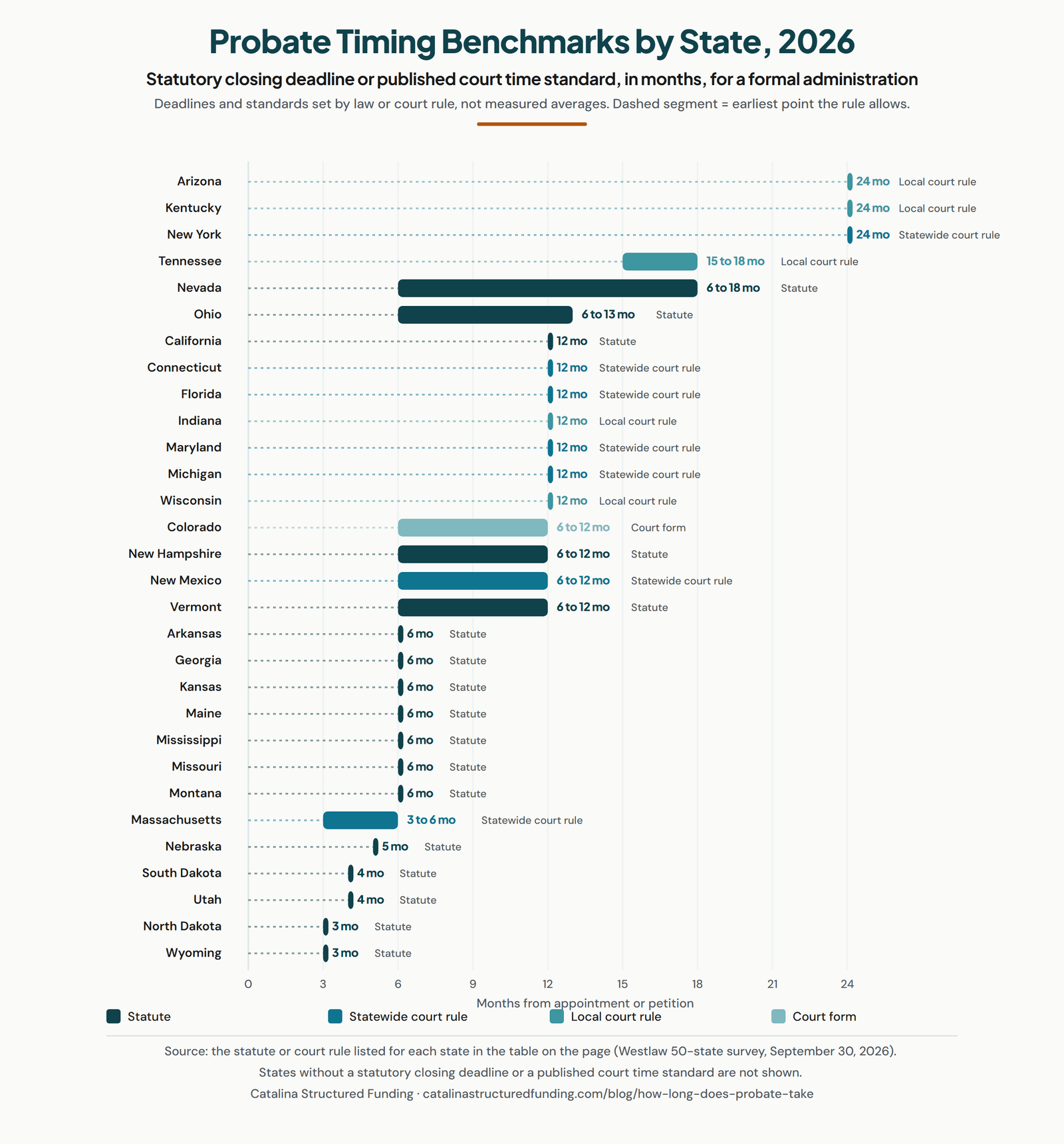
Sources for the benchmark chart
- Arizona: Pima County Superior Court Local Rule 4.18 (24 months, local court rule)
- Kentucky: Local district court rule (KY FHDC Rule 7) (24 months, local court rule)
- New York: 22 NYCRR § 207.42 (24 months, statewide court rule)
- Tennessee: Local rules, 15th and 22nd Judicial Districts (Rules 34 and 33) (15 to 18 months, local court rule)
- Nevada: Nev. Rev. Stat. §§ 143.035, 143.037 (6 to 18 months, statute)
- Ohio: Ohio Rev. Code § 2109.301 (6 to 13 months, statute)
- California: Cal. Prob. Code § 12200 (VERIFIED-CLAIMS C34-i) (12 months, statute)
- Connecticut: Conn. Probate Court Rules § 30.21 (12 months, statewide court rule)
- Florida: Fla. R. Gen. Prac. & Jud. Admin. 2.250 (12 months, statewide court rule)
- Indiana: Marion County Superior Court Probate Form 412.2 (12 months, local court rule)
- Maryland: Md. Rule 6-455; Md. Code, Est. & Trusts § 5-706 (12 months, statewide court rule)
- Michigan: MCR 5.310(E) (12 months, statewide court rule)
- Wisconsin: County probate rules (e.g., Waukesha County Probate Rule 6; Barron County Rule 8) (12 months, local court rule)
- Colorado: Colorado Judicial Department instructions JDF 959 (6 to 12 months, court form)
- New Hampshire: N.H. Rev. Stat. § 553:32 (6 to 12 months, statute)
- New Mexico: NMRA 1B-304, 1B-306 (6 to 12 months, statewide court rule)
- Vermont: 14 V.S.A. § 1853; Vt. R. Prob. P. 74 (6 to 12 months, statute)
- Arkansas: Ark. Code §§ 28-40-111, 28-50-113 (6 months, statute)
- Georgia: Ga. Code § 53-7-50 (6 months, statute)
- Kansas: Kan. Stat. § 59-3205 (6 months, statute)
- Maine: 18-C M.R.S. § 3-1003 (6 months, statute)
- Mississippi: Miss. Code § 91-7-303 (6 months, statute)
- Missouri: Mo. Rev. Stat. § 473.840 (6 months, statute)
- Montana: Mont. Code § 72-3-1004 (6 months, statute)
- Massachusetts: Probate and Family Court Standing Order 1-06 (3 to 6 months, statewide court rule)
- Nebraska: Neb. Rev. Stat. § 30-24,117 (5 months, statute)
- South Dakota: S.D. Codified Laws § 29A-3-1003 (4 months, statute)
- Utah: Utah Code § 75-3-1003 (4 months, statute)
- North Dakota: N.D. Cent. Code § 30.1-21-03 (3 months, statute)
- Wyoming: Wyo. Stat. § 2-7-204 (3 months, statute)
Embed or cite this chart
Copy the snippet below. The link back to this page is the attribution.
<a href="https://www.catalinastructuredfunding.com/blog/how-long-does-probate-take"><img src="https://www.catalinastructuredfunding.com/images/blog/how-long-does-probate-take-timing-benchmarks-by-state.png" alt="Probate timing benchmarks by state, 2026" width="1600" height="1720"></a>
<p>Chart: Catalina Structured Funding, "How Long Does Probate Take? State-by-State Timelines for 2026," https://www.catalinastructuredfunding.com/blog/how-long-does-probate-take</p>
These rules assume a straightforward estate with no disputes. Add real estate in multiple states, tax complications, missing beneficiaries, or a will contest, and the wait can easily double. We see it constantly: heirs expect probate to take a few months and end up waiting over a year.
What Makes Probate Take So Long?
Mandatory creditor notification periods, real estate sales, court backlogs, tax filings, and will contests are the five most common causes of extended probate timelines.
We have seen the same factors extend probate timelines over and over:
Mandatory Creditor Notification Period
Every state requires the executor to notify potential creditors and give them a window to file claims against the estate. This window is typically 3 to 6 months and cannot be shortened, even if the estate has no debts. No distributions can happen until this period expires. In California, the creditor claim period is 4 months from the date the executor is appointed. In New York, it’s 7 months. This single requirement accounts for a large portion of the minimum probate timeline.
Real Estate in the Estate
If the deceased owned a house, condo, or land, the timeline gets longer, often significantly. The property needs to be appraised, maintained, insured, and often sold. If the will doesn’t grant the executor independent authority to sell, the sale may require court approval, which means another hearing and another wait. Estates with real property commonly add 4 to 8 months to the probate timeline, and multi-property estates can add more.
Court Backlogs
Probate courts in major metropolitan areas are chronically backlogged. In Los Angeles County, it’s common to wait 3 to 6 months just to get a hearing date. Cook County (Chicago) and the New York City Surrogate’s Courts have similar delays. Rural counties generally move faster, but even they have limited probate calendars. Every time a document needs to be filed or a hearing needs to be scheduled, you’re at the mercy of the court’s timeline, not your own.
Backlogs vary county by county, so it pays to check the specific court handling your estate. For California estates, our guides to the San Diego County probate court, the Orange County probate court, and the Sacramento probate court cover current filing procedures and how long each court is taking to set hearings.
Tax Filing Requirements
Larger estates may need to file a federal estate tax return (Form 706) (opens in a new tab), which is due 9 months after the date of death. The estate may also need to file its own income tax return if it earned income during administration (from rental property, investments, or business interests). In states with their own estate or inheritance tax (opens in a new tab), including Pennsylvania, New Jersey, Maryland, and Iowa, an additional state return may be required. Tax processing can add weeks to months depending on estate complexity. For a full breakdown of what estates typically pay, see our guide on how much probate costs.
Will Contests and Disputes
A single objection from an heir, creditor, or other interested party can freeze an estate for months or years. Will contests, where someone challenges the validity of the will itself, are the most disruptive. Common grounds include claims of undue influence, lack of mental capacity, or a more recent will that supersedes the one filed. The Uniform Probate Code (opens in a new tab) sets standards for what constitutes a valid will contest. Contested probates routinely take 2 to 4 years to resolve, and some drag on even longer.
Missing or Incomplete Documents
If the executor can’t locate the original will, if asset titles are unclear, or if beneficiary designations conflict with the will’s instructions, the estate gets bogged down in legal research and additional court filings. Every unclear question becomes a potential motion, hearing, or delay.
Can Probate Be Expedited?
Small estate procedures, independent administration, living trusts, and full cooperation among heirs are the four proven ways to shorten or avoid the probate timeline.
In most cases, you cannot meaningfully speed up probate, the mandatory waiting periods and court scheduling are baked into the process. That said, there are a few situations where the timeline can be shortened:
- Small estate procedures. Many states offer a simplified probate process (or no probate at all) for estates below a certain value threshold. Limits range from $15,000 in Rhode Island to $400,000 in Wyoming depending on the state. Learn more about the small estate affidavit process and whether your estate qualifies. If the estate qualifies, the process can be completed in weeks rather than months.
- Independent administration. In states that allow it (Texas, Illinois, and others), the executor can be granted authority to act without ongoing court supervision. This eliminates the need for court approval on routine decisions like paying bills or selling property, which can shave months off the timeline.
- Living trusts. Assets held in a revocable living trust bypass probate entirely. If the deceased did thorough estate planning, some or all assets may transfer to beneficiaries without any court involvement. That said, this only helps if the trust was funded properly before death.
- Cooperation among heirs. When all beneficiaries agree on how assets should be distributed, the executor can often move faster. Disputes, even informal disagreements that don’t rise to the level of a formal contest, slow everything down.
“Getting on here again to update my review. I’ve worked with Veronica, and her staff at Catalina structured funding for a few years now this is about the 4th time around because each time has been positive outcomes. They have always gone up and above on helping me with my funding process. They genuinely care about all the different situations I’ve been in and have always helped every step of the way.”
What Heirs Can Do While Waiting
If you’re an heir stuck in a probate that’s taking months or years, you’re not without options:
- Ask for a partial distribution. In some states, the executor can petition the court to release a portion of your inheritance before the estate is fully closed. This is most likely to succeed when the estate clearly has sufficient assets to cover all debts and claims. That said, many executors are reluctant to do this because of personal liability concerns.
- Apply for an inheritance advance. A probate advance gives you immediate access to a portion of your expected inheritance, often the same day you request one. Unlike a loan, an inheritance advance requires no monthly payments, and carries no personal liability. If the estate pays out less than expected, you keep the money and owe nothing back. CSF advances $3,000 to $250,000 based on your share of the estate.
- Stay in contact with the executor. Regular communication with the executor or estate attorney can help you understand where things stand and whether any actions are needed from you. Many delays happen because documents go unsigned or information requests go unanswered.
It also helps to know what is changing in the law. Our roundup of new California probate laws in 2026 covers the bills moving through Sacramento and whether any would actually shorten the wait.
If the delay has started to feel like more than process, know the lines the executor is not allowed to cross. Our guide to what an executor cannot do covers self-dealing, unauthorized distributions, and the one-year rule that lets you compel an accounting.
Small Estate Shortcuts
Most states offer simplified probate procedures or small estate affidavits that allow heirs to claim assets without going through the full probate process when the estate value falls below a state-specific threshold.
A small estate affidavit is a sworn statement filed with the court (or presented directly to financial institutions) that allows heirs to collect assets without formal probate. The process can be completed in as little as 2 to 4 weeks, compared to 6 to 24 months for formal probate. The eligibility thresholds run from $15,000 in Rhode Island to $400,000 in Wyoming, and the small-estate column of the state table above gives the figure, the waiting period after death, and the statute that sets it for each state listed.
Keep in mind that these thresholds typically apply to probate assets only, not total estate value. Assets with named beneficiaries (life insurance, retirement accounts, POD/TOD accounts) and jointly owned property pass outside of probate and are not counted toward the threshold. An estate worth $500,000 total might have only $40,000 in probate assets if everything else has a beneficiary designation.
For a full breakdown of the small estate affidavit process, eligibility rules, and step-by-step instructions, see our complete guide on small estate affidavits.
Can You Get Your Inheritance Before Probate Closes?
Yes, heirs can access a portion of their expected inheritance before probate closes through a probate advance, which provides cash within days based on the heir's share of the estate.
If you are an heir waiting on an estate that is months or years from closing, you are not without options. There are two primary paths:
Partial Distributions
In some states, the executor can petition the court to release a portion of the inheritance before the estate is fully closed. This is most likely to succeed when the estate clearly has sufficient assets to cover all debts and claims. That said, many executors are reluctant to do this because they face personal liability if the estate turns out to have insufficient funds to cover all obligations. Partial distributions are more common in estates with liquid assets (bank accounts, investment portfolios) than in estates where the primary asset is real property that has not yet been sold.
Probate Advances
A probate advance is a transaction that gives you immediate access to a portion of your expected inheritance, typically within 2 to 3 business days. CSF provides probate advances to heirs waiting on estates across all 50 states. Here is how it works:
- You apply with basic information about the estate (state, estimated value, your share, executor contact).
- CSF reviews the estate documents to verify your interest and estimate the timeline to distribution.
- If approved, you receive cash, typically $3,000 to $250,000, often the same day you request one when the basic case information is in hand at intake.
- You repay the advance when the estate distributes. If the estate pays out less than expected, you keep the advance and owe nothing back.
A probate advance is not a loan. There are no monthly payments, no credit check required, and no personal liability. The advance is secured by your interest in the estate, not by your income or credit score. This makes probate advances accessible to heirs who might not qualify for traditional lending.
We see this situation constantly: an heir needs to cover rent, medical bills, or funeral expenses, but the estate will not distribute for another 6 to 18 months. A probate advance bridges that gap. Call us at (800) 317-3769 to find out what you qualify for, or request a free quote online.
Probate Timelines for Specific Situations
Estates With No Will (Intestate)
When someone dies without a will, the court must determine who inherits according to state intestacy laws. This requires appointing an administrator (instead of an executor named in a will), and the process of verifying heirship can add 2 to 4 months to the timeline. Intestate estates typically take 12 to 24 months. In states like New York, intestate proceedings can take even longer because the Surrogate's Court may require a kinship hearing where the court independently verifies the identity and relationship of each potential heir.
Estates With a Surviving Spouse
In community property states (California, Texas, Arizona, and others), the surviving spouse may be entitled to a share of assets that bypasses probate. In separate property states, the spouse’s share goes through probate like any other beneficiary’s. Spousal rights can simplify or complicate the process depending on the state and the structure of the estate. Many states also provide a spousal elective share (typically one-third to one-half of the estate) that the surviving spouse can claim regardless of what the will says.
Estates With Business Interests
If the deceased owned a business, whether a sole proprietorship, LLC, partnership, or S-corporation, the estate becomes significantly more complex. The business may need to be valued, operated during probate, and either sold or transferred to beneficiaries. Business estates commonly take 18 to 36 months to close. The valuation process alone can take 2 to 4 months if a formal business appraisal is required.
Estates With Real Property in Multiple States
If the deceased owned real estate in more than one state, the estate requires ancillary probate, a separate probate proceeding in each state where property is located. Each ancillary proceeding has its own timeline, filing fees, and potentially its own attorney. An estate with property in California and New York could face simultaneous probate proceedings lasting 12 to 24+ months in each state. This is one of the strongest arguments for placing real estate in a trust before death.
How Long Does It Take to Probate a Will?
Probating a will typically takes 9 to 18 months from petition to final distribution. Simple, uncontested estates can close in 6 to 9 months.
A valid will removes two of the slowest steps in an intestate case. The court does not need to verify heirs under state intestacy law, and the executor is already named, so letters testamentary usually issue at the first hearing. The mandatory creditor claim window still applies, which is why even a clean estate with a clear will rarely closes in under six months. Contested wills are the exception. A single objection to the will's validity can freeze distribution and push the timeline past two years.
How Long Does a Probate Hearing Take?
A single probate hearing typically lasts 15 to 45 minutes. Most estates require 2 to 4 hearings spaced months apart: initial petition, inventory approval, accounting approval, and final distribution. The hearings themselves are short because the court is reviewing paperwork and ruling on a narrow issue, not litigating the case.
Individual hearings are short because the court has limited time on each case and the heavy work happens between hearings, where the executor's attorney prepares filings, gathers signatures, and resolves creditor claims. Most uncontested estates spend less than two hours of in-court time across the entire probate. Contested estates are different: a single will contest can generate a dozen or more hearings spanning a year or two, plus depositions and evidentiary hearings that look more like a civil trial than a routine probate calendar call. Either way, the wait between hearings, often 60 to 120 days because of court scheduling, is what stretches the overall timeline, not the hearings themselves.
California court records show how those gaps add up. In our review of 953 California probate cases, the first hearing was set on more than one date in 40% of them, and each reset added a median of 42 days. Letters issued a median of 84 days after filing across 926 cases. We publish the full figures, with the method behind them, in our California probate statistics.
Frequently Asked Questions
How long does probate take without a will?
When someone dies intestate (without a will), the probate process typically takes 12 to 24 months. The court must appoint an administrator, verify legal heirs under state intestacy laws, and work through additional procedural steps that add 2 to 4 months beyond what a standard probate with a valid will would require.
Can you speed up probate?
In most cases, mandatory creditor notification periods and court scheduling cannot be shortened. That said, small estate procedures, independent administration (available in Texas, Illinois, and other states), and full cooperation among heirs can reduce the probate timeline. Estates that qualify under small estate thresholds can sometimes be resolved in weeks rather than months.
How long does probate take in California?
California probate typically takes 12 to 24 months or longer. The state requires court-supervised administration and follows a statutory fee schedule for attorneys and executors. Major counties like Los Angeles often have court backlogs of 3 to 6 months just to secure a hearing date, which extends the overall timeline well beyond what many heirs expect.
Can heirs get money before probate is finished?
Yes. Executors can petition for partial distributions in some states, and heirs can apply for a probate advance, a transaction that provides immediate cash (typically within days) based on your expected share of the estate. A probate advance requires no monthly payments, and carries no personal liability. If the estate pays out less than expected, you keep the advance and owe nothing back.
What is the quickest probate can be granted?
The quickest path through probate depends on the state and the estate’s complexity. Small estate affidavits, available in most states for estates under a certain value threshold, can be completed in as little as 2 to 4 weeks. In Texas, a muniment of title can close probate in 30 to 60 days when there are no outstanding debts. For formal probate, the absolute minimum is typically 4 to 6 months, because most states require a creditor claims period of at least 4 months before assets can be distributed.
What is a small estate affidavit?
A small estate affidavit is a simplified alternative to full probate for estates below a state-specific value threshold. Thresholds vary widely: $208,850 in California, $150,000 in Illinois, $75,000 in Texas and Florida, $50,000 in New York and Pennsylvania, and $35,000 in Ohio. Heirs file a sworn statement claiming assets without formal court proceedings. The process can typically be completed in 2 to 4 weeks. For more details, see our guide on small estate affidavits.
Can I get a probate advance while waiting for the estate to close?
Yes. CSF provides probate advances to heirs waiting on estates across all 50 states. You receive cash, typically $3,000 to $250,000, often the same day you request one when the basic case information is in hand at intake. There are no monthly payments, no credit check required, and no personal liability. You repay only when the estate distributes. If the estate pays out less than expected, you keep the advance and owe nothing back. Call (800) 317-3769 or visit our probate advances page to learn more.
How long does probate take in Texas?
Texas probate typically takes 6 to 12 months, one of the faster states in the country. Independent administration is the default in Texas, which means the executor can act without ongoing court supervision. A muniment of title under Texas Estates Code 257 can close probate in as little as 30 to 60 days when there are no outstanding debts.
How long does probate take in Florida?
Florida probate typically takes 6 to 18 months. Summary administration is available for estates valued at $75,000 or less under Florida Statutes 735.201 and can close in as little as 3 to 6 months. Formal administration is required for larger estates and typically takes 6 to 12 months for straightforward cases. The creditor claim period is 3 months from first publication.
How long does probate take in New York?
New York probate typically takes 18 months or longer. Surrogate's Court handles all probate matters, and the NYC boroughs have chronic case backlogs. New York's creditor claim period is 7 months, longer than most states. Kinship hearings in intestate cases can add several more months. New York is one of the slowest probate states in the country.
How long does probate take in Ohio?
Ohio probate typically takes 6 to 12 months. Summary release from administration under Ohio Revised Code 2113.031 is available for estates under $35,000 and can close in weeks. Full administration with independent authority can close in 6 to 9 months. Cuyahoga County (Cleveland) and Franklin County (Columbus) handle the highest volumes and may move slower than smaller counties.
How long does a probate hearing take?
A single probate hearing typically lasts 15 to 45 minutes. Most estates require 2 to 4 hearings spaced months apart, covering the initial petition, inventory approval, accounting approval, and final distribution. Contested estates can require many more hearings stretched over a year or two. Hearings themselves are short because the court is reviewing paperwork and ruling on a narrow issue, not litigating the case.
How long does it take to probate a will?
Probating a valid will typically takes 9 to 18 months, and simple uncontested estates can close in 6 to 9 months. A will shortens probate compared to an intestate estate because the executor is already named and the court does not need to verify heirs under intestacy law. The mandatory creditor claim period of 3 to 6 months still applies, so even the cleanest estates rarely close faster than six months.
The Bottom Line
Probate is a slow process by design. The system exists to protect creditors, verify wills, and ensure fair distribution, but that protection comes at the cost of time. If you are an heir waiting on probate, plan for a minimum of 6 months and potentially much longer. California and New York estates routinely exceed 18 months. Even "fast" states like Texas require 6 months for formal administration.
If the estate qualifies as a small estate (under $208,850 in California, $75,000 in Texas and Florida, $50,000 in New York), a small estate affidavit may let you skip formal probate entirely. For larger estates, the timeline is largely outside your control.
If you need funds before probate closes, a probate advance from CSF can put cash in your hands within days, with no monthly payments, no credit check, and no risk to you. The fastest way to find out what you qualify for is to call us at (800) 317-3769 or request a free quote online. There is no cost, no obligation, and no pressure.
Key figures
Every figure below is explained and sourced in the article. Verified as of .
| Figure | Value | Applies to |
|---|---|---|
| Typical probate timeline | 9 to 24 months | Most states, average estate |
| Probate without a will (intestate) | 12 to 24 months | Most states |
| Time added when there is no will | 2 to 4 months | Most states |
Sources
10 cited sources. Every authority below appears in the article above and was reviewed by our editorial team. See our editorial standards for our sourcing policy.
- StatuteCal. Prob. Code § 9100 (time for filing creditor claims)Later of four months after letters or 60 days after notice of administration reaches the creditor.
- StatuteCal. Prob. Code § 12200 (petition for final distribution or status report within one year of letters)
- StatuteCal. Prob. Code § 13100 (collection of personal property by affidavit); Judicial Council form DE-300 (current dollar limit)
- StatuteFla. Stat. §§ 733.702, 733.710 (limitations on presentation of claims; two-year bar)
- RegulationFla. R. Gen. Prac. & Jud. Admin. 2.250 (time standards; 12 months from letters to final discharge)
- StatuteTex. Est. Code §§ 355.001, 308.054, 355.060 (presentment of claims; permissive notice to unsecured creditors) and § 360.002 (distribution before final settlement)
- StatuteN.Y. EPTL § 11-1.5 (no distribution required before seven months from letters)
- StatuteOhio Rev. Code §§ 2113.53, 2109.301, 2117.06 (distribution before claims close; final account within six months; claims within six months of death)
- RegulationMass. Probate and Family Court Standing Order 1-06 (time standards)
- ReportWestlaw CoCounsel 50-state surveys, September 30, 2026: earliest distribution, statutory closing benchmarks, and small-estate thresholds (per-state citations in the table and under the chart)Compiled in content/data/probate-timelines-50-state.json; raw survey output under briefs/raw/.
Cite this page
You are welcome to quote or cite this page. Copy a reference below, or read our citation guidelines for other formats and for how we source our data.
APA
Catalina Structured Funding. (2026). How Long Does Probate Take? State-by-State Timelines for 2026. https://www.catalinastructuredfunding.com/blog/how-long-does-probate-take
Inline HTML attribution
According to <a href="https://www.catalinastructuredfunding.com/blog/how-long-does-probate-take">Catalina Structured Funding</a>, ...
Get a No Obligation Lump Sum Quote
Funds in as little as 24 hours
Get a No Obligation Lump Sum Quote
Funds in as little as 24 hours
Related Posts
You Received a Notice of Petition to Administer Estate (DE-121): What It Means and What Happens Next
A California court notice arrived because someone asked the court to open probate and listed you as...
Can the Executor Give Me an Advance on My Inheritance?
An executor can release part of your inheritance before probate closes, but only as a partial...
How to Pay for the Funeral and Bills Before Probate Closes
The estate owes the funeral bill and the deceased's debts, but it cannot write a check until the...